
The results of observation and analysis of the stars in the Galactic Center region show that the supermassive black hole (Sagittarius A*) exists in this region (see e. g., [1]). The studying of the redshift of light of these stars gives us possibilities for testing theories of gravity (see e. g., [2, 3]). The binary systems can exist among these stars (see e. g., [4]). And this provide possibilities for calculation of addition parameters of motion and hence, for more exact tests.
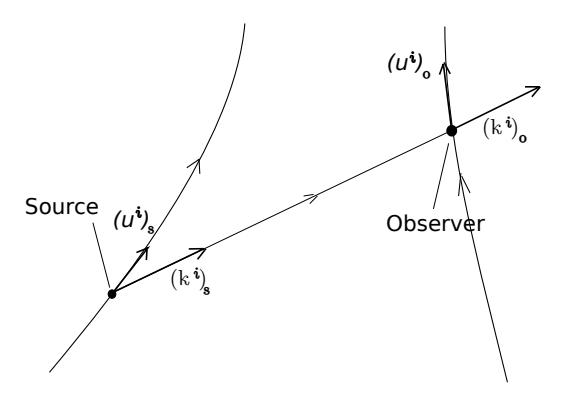
In the general case the gravitational field of astrophysical black hole can be considered as a Kerr metric. In this work we present the method for the calculation of redshift as a function of time for the source in binary star system that moves in external gravitational field of Kerr black hole. For the calculation of the redshift it is necessary to solve the edge problem for the isotropic geodesics in external gravitational field (see Fig. 1). For this purpose we use the decomposition of redshift into two parts. The first one gives the redshift from the source that moves along geodesic, and the second part is the redshift from the relative motion of the two stars (see [5]). We use the analytical expressions for the geodesics in Kerr metric and this gives us possibilities to use our results in the case of strong gravitational field, when binary system moves very close to the supermassive black hole horizon.
The assumption about the existence of large number of binary pulsars in the vicinity of Sagittarius A* is presented in many scientific publications (see e. g. [6]). Due to the simple relation between the redshift and the time delay of the pulse of pulsar (see e. g. [6]) one can use our results also for studying of the Galactic Center pulsar timing data.