
Organic light-emitting devices (OLEDs) already dominate the smartphone and tablet display market due to low power consumption, relatively cheap mass production technology and potential flexibility [1]. In most cases phosphorescent OLEDs capable of converting 100% of created excitons into photons are used. Unfortunately, emitters in these devices contain heavy metal (typically iridium or platinum) atoms, which make them rather expensive. Recently, next generation OLEDs based on thermally activated delayed fluorescence (TADF) were realized. This phenomenon also enables achieving 100% of internal quantum efficiency by reverse inter-system crossing (RISC) from exciton triplet state to radiative singlet state in the materials with small singlet-triplet energy separation (of a few kBT) [2]. Although substantial progress has been made in research of blue-orange TADF OLEDs only a few attempts were made to realize efficient red TADF OLEDs. Main difficulties arise from the enhanced non-radiative decay in low bandgap emitters. Moreover, to avoid emitter concentration quenching in OLEDs, emissive (guest) molecules are doped in a host material at low concentration. TPBi is a widely used host [3,4], however, due to the wide energy gap between the highest occupied and lowest unoccupied molecular orbitals and relatively small hole mobility, it may not be the optimal host option. In this work we investigate new host materials (alternatives to TPBi) based on phenantroimidazole, possessing narrower energy gap and exhibiting bipolar charge transport.
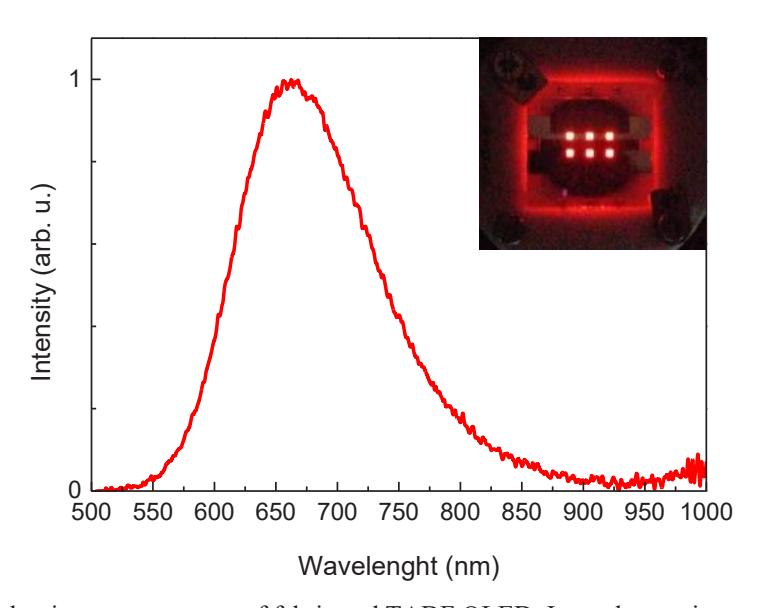
The search of the suitable host material for deep red TADF emitter – TPA-DCPP (TPA = triphenylamine; DCPP = 2,3-dicyanopyrazino phenanthrene), referred as a guest, was conducted by estimating Förster resonance energy transfer rate from various phenantroimidazole hosts to the guest. To this end, we evaluated fluorescence spectrum, internal quantum efficiency (IQE) and excited state lifetime of the hosts and absorption spectrum of the guest. Additionally, concentration quenching experiments were carried out for the guest-host films with different guest concentrations (0.1 - 10%) to find the optimal one. Triplet energies of the hosts were deduced from their phosphorescence spectra to assure sufficient triplet exciton confinement in the emitter, i.e. negligible back-energy-transfer to a host. Finally, the selected optimal hosts were tested in red TADF OLEDs fabricated by thermal evaporation in a high vacuum. Main OLED characteristics, i.e. external quantum efficiency (EQE), current efficiency, efficiency roll-off, I-V characteristics, and electroluminescence spectra were measured. OLED structure optimization was done considering electron and hole current balance. Optimized OLED was compared with a device using conventional TPBI host.