
The market of counterfeit goods grows each year. This causes companies that produce the original goods an immense amount of money that were put in product development. Moreover, counterfeit medicine and other chemicals besides the financial damage are also harmful to people and environment and causes thousands of deaths annually [1]. One of the options to recognize the original product is marking it with luminescent security pigments. In this work we present three novel luminescent materials based on GdBSb2O8 host matrix doped with Tb3+, Sm3+, and Eu3+ ions. All of the prepared phosphors possess unique emission spectra that are beneficial for application in luminescent security pigments.
Three sets of GdBSb2O8 compounds doped with 1%-100% Tb3+, Sm3+, and Eu3+ ions were prepared by high temperature solid state synthesis method from high purity Gd2O3, H3BO3, SbO2, Tb4O7/Sm2O3/Eu2O3 starting materials. The structural, morphological and optical characteristics of the compounds were investigated by powder X-ray diffraction (XRD), scanning electron microscope (SEM) analysis and UV-Visible spectroscopy. The reflection, excitation and emission spectra as well as photoluminescence (PL) decay curves were measured at room temperature and analysed. Temperature dependent emission spectra and PL decay curves in 77–500 K interval were recorded and thermal quenching activation energies ($E_a$) calculated. Moreover, room temperature and temperature dependent (77–500 K) colour coordinates for 1931 CIE colour space diagram were calculated from emission spectra and will be discussed.
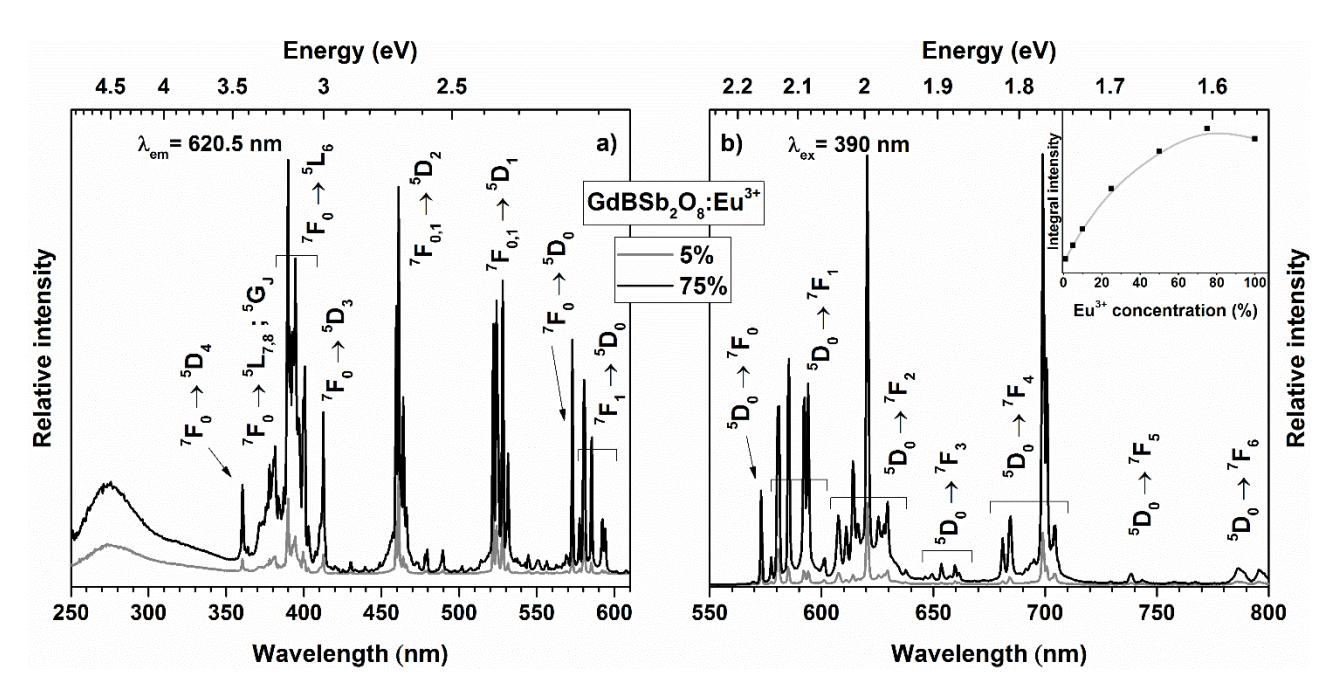
The excitation and emission spectra of GdBSb2O8 doped with 5% and 75% Eu3+ are given in Fig. 1. Excitation spectra (Fig. 1a) contain several sets of intensive lines at ca. 390, 460, 525, and 580 nm originating from 7F0 → 5LJ; 5GJ, 7F0,1 → 5D2, 7F0,1 → 5D1, and 7F0,1 → 5D0 transitions of Eu3+ ions, respectively. Intensive excitation lines indicate that these compounds can be excited in a wide wavelength range. Emission spectra (Fig. 1b) of these compounds, in turn, also possess several sets of intensive emission lines at ca. 580, 620, and 700 nm that are attributed to 5D0 → 7F0,1, 5D0 → 7F2, and 5D0 → 7F4 Eu3+ transitions, respectively. The integrated emission also indicated (see inset of Fig. 1b) that strongest emission was observed for the sample doped with 75% Eu3+ leading to a conclusion that concentration quenching occurs if the activator concentration is further increased.