
Nowadays, the issue of regulating the anthropogenic emissions of greenhouse gases, such as CO2, CH4, N2O, which is mainly associated with the burning of traditional types of hydrocarbon fuels, is acute. One of the solutions to overcome this problem is the implementation and use of alternative clean energy sources. For this reason solar energy and hydrogen economy are promising. The conversion of water into hydrogen using solar energy and semiconductor photocatalytic coatings have attracted much attention due to the use of only water and solar energy, which are abundant, renewable and easily accessible natural resources [1-3].
Therefore, in this work we formed copper oxide (I, II) composites using electrochemical anodization of copper foil and copper thin film deposited on nanostructured silicon surface. Anodization was carried out in aqueous solution of sodium hydroxide at different current densities for 30 min. UV-Vis, photoluminescent and Raman spectroscopy (Fig. 1) were used to study of structural and optical properties. Photoelectrochemical properties of samples was studied using three-electrode cell configuration, where copper oxide composites, silver chloride and ruthenium oxide were as working, reference and counter electrodes, correspondingly.
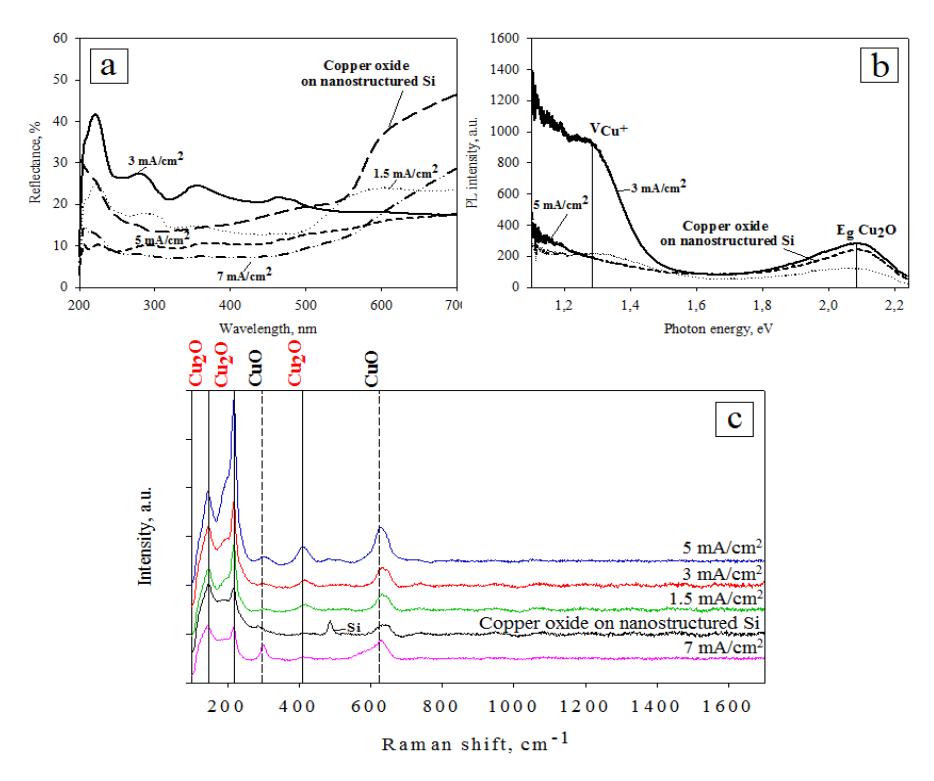
It was found that all of the obtained samples contain both copper oxide (I) (Cu2O) and copper oxide (II) (CuO). The optical band-gap of Cu2O calculated from photoluminescence spectra is about 2.1 eV. Reflectance of the samples varied from 10 to 45 % in the 200 – 700 nm spectral range. Voltammetric study of the samples showed the increase of current density in the samples under illumination. Therefore, developed formation method of copper oxide photoelectrodes opens prospects for obtaining high-effective, stable and low-cost photoelectrode for solar water splitting cells.