
Conventional processing methods of glass cannot fulfil evergrowing industrial requirements for processing speed and quality. For that reason these days glass processing is usually done by employing various laser-based techniques. One of the most material and energy efficient glass cutting techniques is to locally weaken the material along the cutting path by generating cracks or material modifications and then separate the sheets by applying thermal or mechanical load. This method results in a smooth cut with an infinitely thin kerf width and in most cases there is no need of additional processing [1].
Bessel-Gaussian beams are very appealing for glass processing because of their authentic properties such as the long non-diffracting propagation length and rapid reconstruction behind an obstacle. However generating glass modifications with a symetrical Bessel-Gaussian beam is not ideal as glass modifications are random and negatively influence speed and quality of the cut, thus arises a need to make the modifications directional and easily controlled.
It was shown that the asymmetrical Bessel-Gaussian beams can be formed by filtering its spectrum of spacial frequencies after compensating the aberrations emerged because of the axicon's elliptical base [2]. We have proved that such beams in turn generate directional cracks in the bulk of the glass.
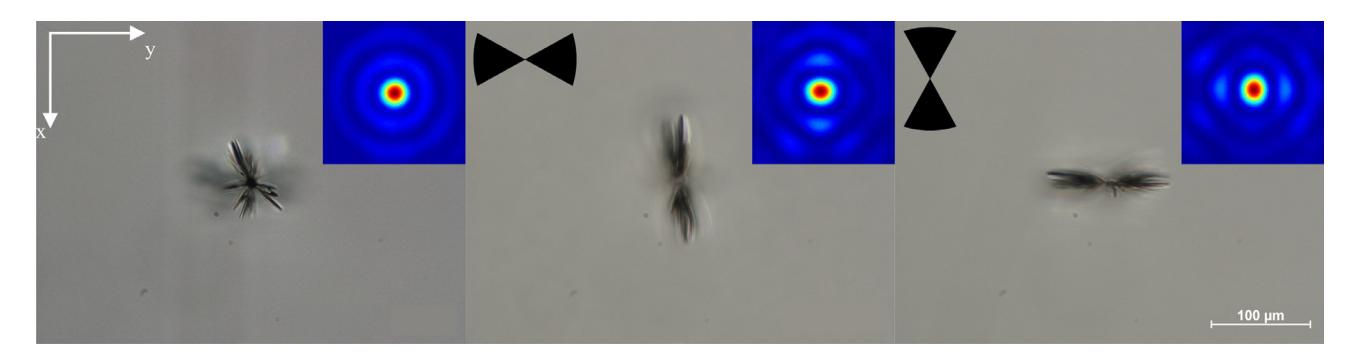
Furthermore, generated cracks are easily controlled by changing the filter's position in respect to the cutting direction. Also, when compared with cracks made by a non-filtrated beam without the correction of aberrations, the cracks made by a filtrated beam with compensated aberrations were more than twice as large in respect of cracked area. These results are indeed promising as the cracks generated using such asymmetrical beams could greatly increase both speed and quality of the cutting process.