
In laser material processing applications specific requirements for beam shapes among other properties exist. Hence, methods for generating desired intensity distributions in the transverse plane may serve as door openers for novel approaches and applications. In recent years the optical beams with controllable shape and long focal depth lines have attracted attention for their potential uses in material processing, lithography applications [1, 2].
Mathieu beams have elliptical intensity distribution perceivable as “optical knives" and belong to a family of non-diffracting electromagnetic waves. Here, the beam shape in the transverse plane is retained over a relatively long distance, so that it appears not to be affected by diffraction in free space and can therefore be called propagation invariant.
In contrast to Bessel beam–like shapes the Mathieu beams have asymmetric cross section, which is controlled via order - m and ellipticity - q parameters [1]. The zeroth order beams have the appearance of “optical knives", where the transverse plane distribution can be altered using ellipticity parameter and the desired axial distribution could be constructed by superposition of multiple beams.
A spatial light modulator (SLM) is a dynamic diffractive optical element which enables experimental generation of a desired beam shape through the manipulation of the incident beam phase distribution. However, an important limitation on the implementable beam parameters are the low and high spatial frequency limits in the beam spatial spectra. This limitation stems from the finite size and resolution of the SLM and therefore requires close attention to the beam spatial spectra.
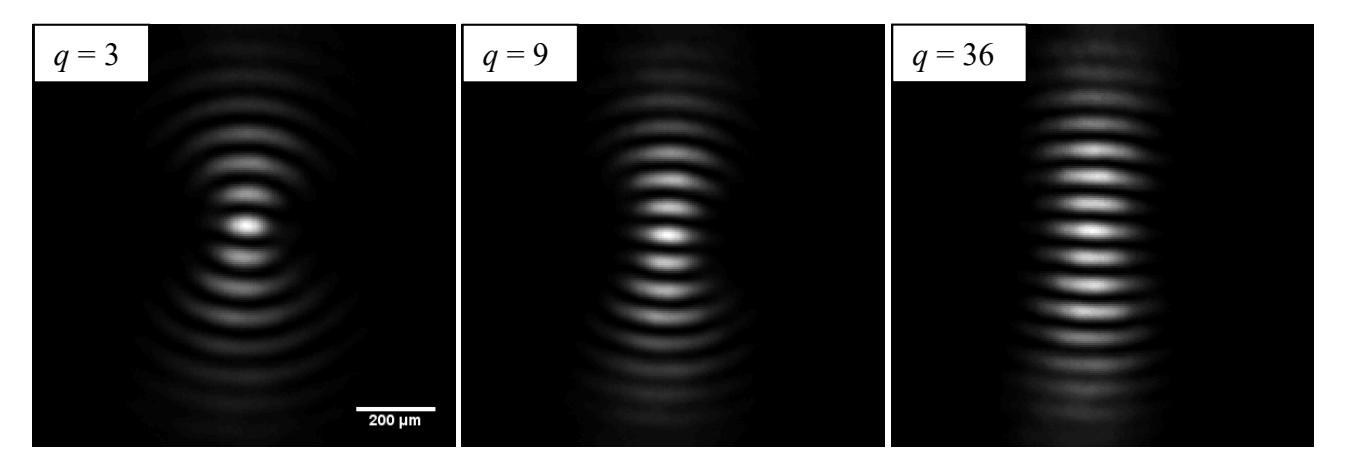
In this work we investigate the transverse plane intensity distributions generated with numerically generated phase masks using SLM. An example of controlling the beam shape is given in Fig. 1 where increasing the ellipticity parameter results in development of wider and flatter “knives”. Similarly the number of parallel “knife” elements can be varied. We report on our achievements in experimentally generating Mathieu beams of different parameter configurations.