
Saccharomyces cerevisiae is one of the most well-studied and understood eukaryotic organisms. The studies of yeast cell allow to reconstitute a possible molecular mechanisms of various abiotic effects.
Pulsed electric field is one of the most intensively investigated abiotic effects on biological tissues and cell suspensions for past decade. It has been previously shown that a nanosecond pulsed electric field (nsPEF) permeabilize the plasma membrane, alter gene expression, cause phosphatidylserine translocation, affect the distribution of intracellular ions and even lead to the death of mammalian cells. There is still a lack of sufficient data related to the effects of nsPEF on yeast cells yet.
In our study we analyzed the effects of square shaped electrical pulses of different duration (${\tau}$= 10-90 ns) and pulse number (pn= 1-5) with electric field strength (E) up to 220 kV/cm and showed that nanosecond pulses can induce the yeast cell death, which in turn is dependent on the electric field pulse parameters and increase with the rise in E, ${\tau}$ and pulse number. Exposure of yeast cells to nsPEFs was accompanied by metacaspase activation (Fig. 1), membrane permeability to propidium iodide and the externalisation of phosphatidylserine [1].
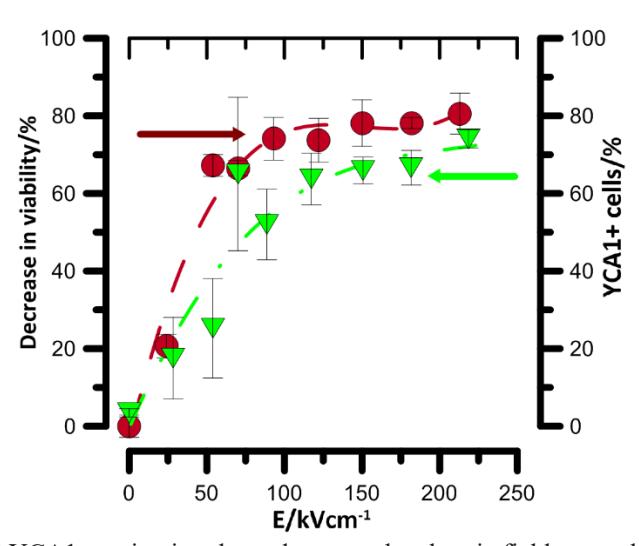
Furthermore, the investigation of yeast cells permeabilization to tetraphenylphosphonium ions (TPP+), which was induced by high power nanosecond duration electrical pulses, had demonstrated the following features: (i) The study of TPP+ ions absorption rate by yeast cells is an effective method for detection of short duration electric pulse influence on yeast cell wall properties; (ii) Shortening of the electric pulse duration makes it possible to achieve more homogeneous electrical treatment of yeast cell clusters and by this way to increase the effectiveness of single cell permeabilization; (iii) The significant acceleration of TPP+ ions absorption rate (up to 65 times) can be achieved without any influence on the vitality of the cells [2].
We conclude that square shaped electric field pulses with nanosecond durations induce wide variety of effects including caspase-dependent apoptosis, oxidative stress, cell wall permeabilization, and that such abiotic treatment can be used in various fields starting from food safety and ending in medicine.