
The very first demonstrations of the Laser-Induced Breakdown Spectroscopy (LIBS) took place in late 60s of the twentieth century [1], nowadays LIBS applications span from handheld metal scrap analyzers [2] to more complex systems for planetary exploration [3]. For the laser sources used in handheld analyzers there are no strict requirements to laser output parameters: beam quality and spatial energy distribution are not specified; there is no need for SLM operation and low timing jitter; the single pulse energy is usually low, about 150 µJ (although there are 5-6 mJ versions on the market); laser pulse energy stability is not specified if the laser peak fluence exceeds the material ablation threshold. At the opposite side, the systems developed for planetary exploration are usually quite expensive and tailored for particular mission requirements. Between these two extremes various applications exist which require compact laser sources with pulse energies of several mJ, excellent beam quality, and stable energetic and temporal characteristics. One such industrial application is the precise and accurate determination of coating thickness and/or fast and reliable detection of chemical and structural irregularities during the surface refinement process.
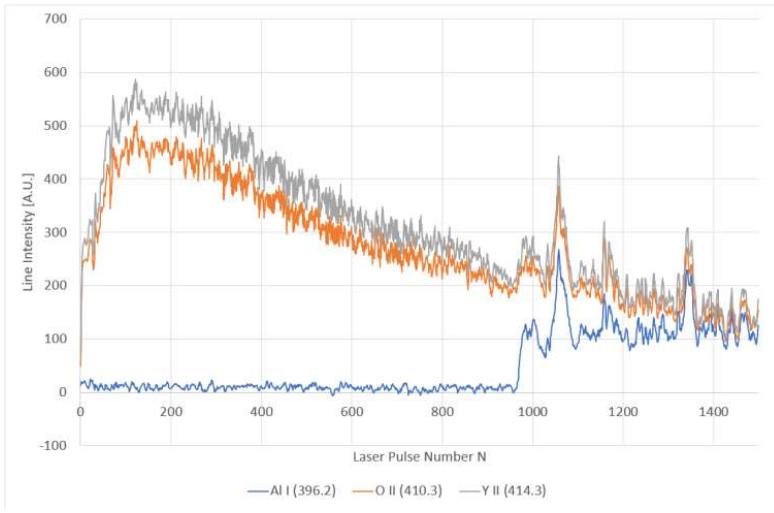
The present work demonstrates the applicability of Standa's IR passively Q-switched sub-nanosecond lasers for precise, reliable, and reproducible micro-invasive depth profiling of multilayer ceramic coatings. The excitation laser used in the experiments delivered 1mJ, 600 ps laser pulses at 100 Hz with wavelength of 1064 nm. The advanced laser oscillator design ensured SLM operation, high pulse to pulse energy stability, and excellent laser beam quality. The laser beam was expanded by a 10x beam expander and then focused with a f=150 mm lens onto the sample surface. Plasma emission was collected by a two-mirror system and launched into multimode fiber. The opposite fiber tip illuminated the entrance slit of the spectrometer. The typical ablation rates were around 100 nm/pulse. The depth-profile of the Yttria coated Aluminum sample is shown on the image below.
In future works we plan to use the developed laser system in analysis of multilayer metal samples to further expand its applications range, and investigate the effect of second harmonic on ablation rates and layers profiling.