
Semi-metals and narrow-gap semiconductors have found lot of applications in various branches of modern electronics: thermoelectricity, THz generation, infrared emitters, etc. This makes crucial for scientific community to understand the various factors (like temperature and doping) affecting the electronic properties in this class of materials. However, current-day knowledge of temperature, doping and morphology effect on those properties needs further development. With Bi-based alloys as model material we demonstrated how the modern advantages in galvanomagnetic measurements processing allow the better understanding the doping effect on charge carrier parameters.
The modern quantitative mobility spectrum analysis (QMSA) methods use resistivity and Hall data in all available range of magnetic fields and require minimum external input parameters for the computational procedure. This makes QMSA very promising tool for investigation of electronic states in diluted BiSn alloys. The result of QMSA procedure are extracted mobilities and concentrations (the last allow tracking of band extrema on energy scale).
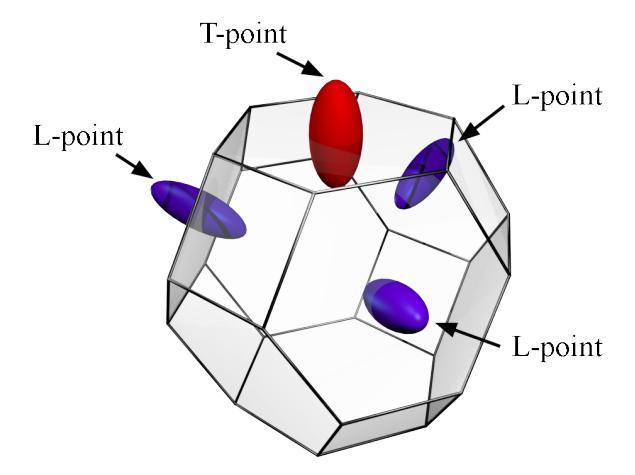
The positions of Fermi level relative to extrema of electronic pockets were determined from statistical physics integrals
$$n = \int_0^\infty \frac{8\pi\sqrt{2}}{h^3} m^{3/2} \frac{\sqrt{E}}{e^{\frac{E-\zeta}{k_B T} + 1}} dE, \tag{1}$$where m is the effective mass, $ \zeta $ is Fermi level position, T is temperature, $k_B$, h are Boltzmann's and Planck's constants respectively.
It was shown that band overlap Eo decreases in BiSn with the increase of Sn concentration and that Eo for samples with Sn concentration x ≥ 0.02 at. % reduces with temperature (until zero overlap for x = 0.08 at. %, T = 300 K). These changes in electronic band structure mean, in fact, the transition of BiSn system from semimetal to the narrow-gap semiconductor.