
Ionic liquids are organic salts composed of relatively large asymmetric organic cations and weakly coordinated organic or inorganic anions, and they are characterized by a relatively low melting point. Due to their unique properties, ionic liquids are promising materials for many applications in bio-nanotechnology or chemical industry. They are already now used as nontoxic solvents or electrolytes in high-performance lithium-ion batteries, fuel and solar cells. Large number of ionic liquids with desirable properties can in principle be created by combining different cations and anions. The rational design of ionic liquids can only be achieved if accurate prediction of its properties based solely on the knowledge of the constituent ions is possible. This would open the door for control and optimization of the properties of the newly developed ionic liquids. To this end, the understanding of the structure and dynamics of the ions at the molecular level is indispensable. The main task of present work is to evaluate the temperature dependence of the self-diffusion coefficient of several imidazolium based ionic liquids using classical molecular dynamics (MD) simulations. Our computational predictions are compared to available experimental data.
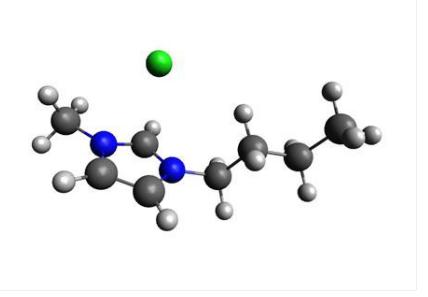
We have considered the ionic liquids composed of 1-butyl-3-methyl-imidazolium, C4mim, and four different anions including chloride, iodide, bromide and tetrafluoroborate, BF4, see Fig. 1 for the structure of [C4mim][Cl] ionic pair. The molecular dynamics simulations are based on classical equations of the motion, and the potential energy function of the system is to be considered in order to solve those equations. We have adopted Amber type force fields for the molecular systems we simulate. The MD simulations were carried out using the AMBER program. The diffusion coefficients were evaluated using the Einstein equation, and the mean-square displacement function was obtained by sampling the trajectory of the simulated system for the duration of 1 ns. Charge reductions scheme was utilized to account for charge transfer intermolecular. We have also applied reduced charge scheme in order to effectively take the intermolecular charge transfer interactions into account. Self-diffusion coefficients of the cations were considered for the temperatures in the range of 283 to 343 K.