
Recent research in the field of flame manipulation and fire suppression has yielded admirable results. In the reference [1] a method is described for manipulating laboratory-grade flames by applying time-varying oscillating electric fields. Described methods could potentially be used in the future as a means of suppressing fires from a distance in places inaccessible to firefighters. In order to construct effective apparatus utilizing this effect, we must first explore in depth the nature of flame-field interactions.
In this project, a computer simulation of a laminar hydrogen flame is constructed, capable of demonstrating and quantifying its interactions with external electro-magnetic fields. This simulation could be used to extrapolate existing empirical data on flames of other sizes and fuels, thus allowing for a better understanding of the behavior of flames in externally applied fields.
Since flame is the unstable transitional stage of a combustion reaction and it consists of electrons, ions and neutral particles moving at high speeds and recombining frequently [2], we propose that it is possible to make a numerical model of flames as plasmas of low temperatures and densities. A suitable method for such simulations is called the Particle-in-Cell (PIC) method (described in [3]), due to its faithful representation of the interaction between plasma particles and external fields. This method reduces the complexity of the simulation by using the Lorentz equation instead of the Coulomb relation for calculating the force exerted on a particle, while utilizing the Debye shielding effect to group individual particles into superparticles, thus further reducing computational cost. Electric field values (external and self-induced by the particles) are calculated only in discrete points in space defined by the nodes of a square lattice positioned over the simulated plasma interface, and are derived using the finite-difference method. As part of the presentation, the PIC model and its application to this specific problem will be explained, focusing on its benefits over other possible simulation methods.
We have constructed a 2D electrostatic PIC simulation of a premixed hydrogen flame using the MatLab toolkit, which has the capabilities to demonstrate the behavior of flames in homogenous time-invariant external electric fields, as illustrated in Fig. 1. Here, negatively charged species of a flame are shown to be deflecting towards the positive electrode in a homogenous electric field. This confirms that models used in plasma physics (such as PIC) could potentially be used as reliable simulation methods in combustion physics.
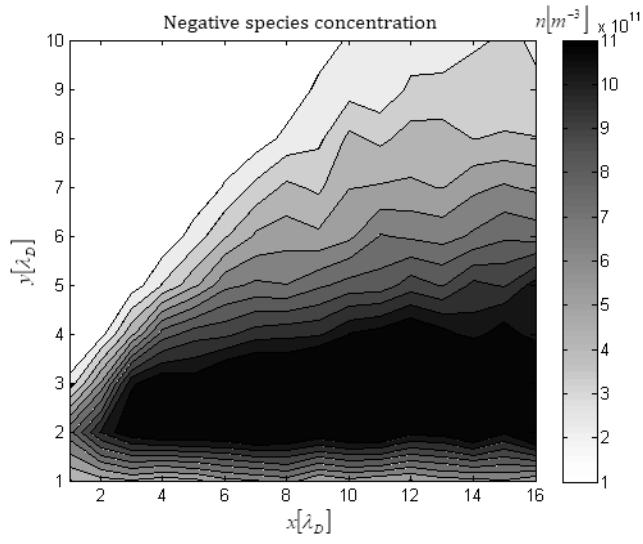
In order to further develop the model, we are adding the ability to simulate time- and space-varying electric fields. To simulate the magnetic components of EM waves we will be using the Boris integrator method [3] for evaluating the velocity vector rotation in a magnetic field arising from the Lorentz force. Finally, since real flames contain many neutral species which are unaffected by EM fields, we will include an adequate "drag factor" as a proposed method to account for the flow-restricting nature of collisions between neutral and charged particles in a flame.