Metal-organic frameworks (MOFs) have emerged in the recent years as promising materials as their physical properties suggest variety of applications in gas absorption and storage containers, microreactors, etc.[1] due to their porous structure. In this research two MOF materials were studied: ZIF-90 and UIO-66.
UIO-66 and ZIF-90 powders were prepared for dielectric studies by compressing them into cylindrical pellets and evaporating silver electrodes on their flat surfaces to obtain an ohmic contact with the measurement cell. Dielectric properties were measured at five different atmospheres: N2, CO2, H2O, C2H5OH and vacuum, in 100 K – 400 K temperature region sweeping the measurement frequency in 100 Hz – 1 MHz range.
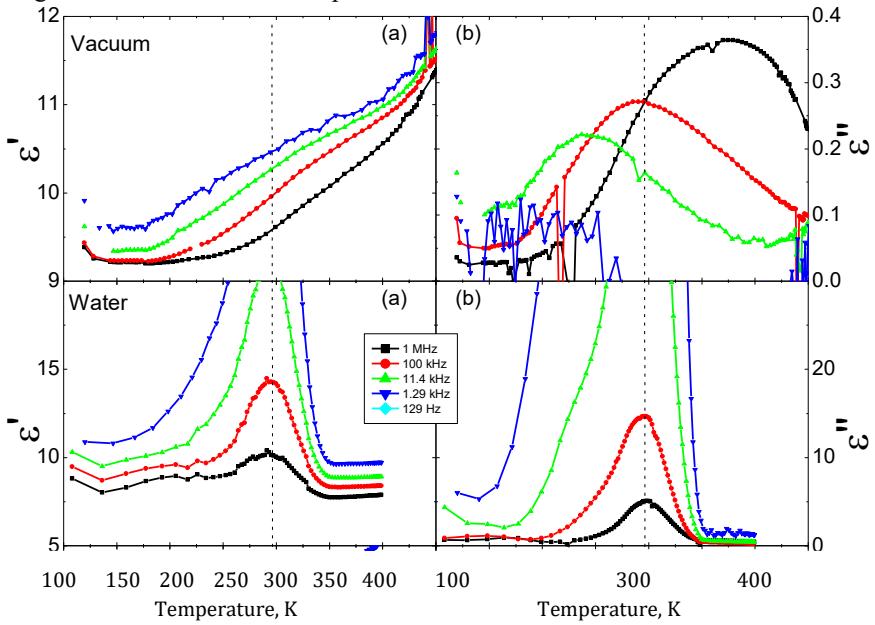
In this presentation data obtained during dielectric studies of UIO-66 and ZIF-90 in various atmospheres will be presented. From Figure 1 we can observe that in humid conditions ZIF - 90 experiences anomaly at room temperature. As temperature increases dielectric permittivity increases in all frequencies and experiences maximum at 300K, as temperature further increases permittivity drops, similar results were obtained with UIO-66 as well. No significant anomalies of dielectric permittivity were observed for measurements in non-polar gas (nitrogen and carbon dioxide) atmosphere.
Experimental data of both UIO-66 and ZIF-90 were approximated by Cole-Cole equation [2] which helped to distinguish Maxwell-Wagner relaxation due to absorption of water molecules into the structure.