Acute promyelocytic leukemia (APL) is a hematological malignancy driven by a chimeric oncoprotein containing the C terminus of the retinoic acid receptor-α (RARα) fused to a N-terminal partner, most commonly promyelocytic leukemia protein (PML) [1]. The main genetic feature (90% APL cases) of this disease is chromosomal translocation t(15;17) (q22;q12). Normally RARα regulates gene expression through a co-repressor complex containing histone deacetylase (HDAC) activities that induces chromatin condensation and transcriptional repression. When mutated PML-RARα protein forms, it does not respond to its natural ligand retinoic acid (RA) allowing uncontrolled cells proliferation at the promyelocyte stage. Pharmacological doses of RA are used to treat patients in so-called differentiation therapy [2]. However, RA has limited activity as single therapeutic agent and not all patients respond to RA treatment, or after initial success relapse can arise. RA therapy could be improved with combinations of epigenetic agents, such as histone deacetylases, methyltransferases.
In the present study, we aimed to investigate the effects of combination of retinoic acid, histone deacetylases inhibitor belinostat (Bel) and histone methyltransferase EZH2 inhibitor 3-deazaneplanocin A (DZNep) on NB4 cell line and APL patient bone marrow cells with PML-RARα translocation. Cell proliferation and viability were evaluated by the trypan blue exclusion test. Cell differentiation was determined by microscopic nitroblue tetrazolium assay and gene expression changes were evaluated by using RT-qPCR.
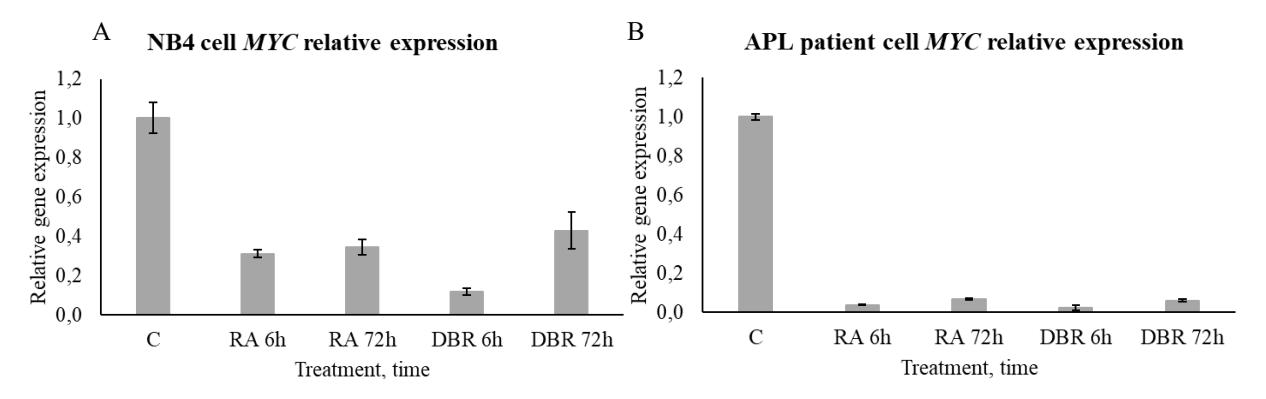
NB4 cell treatment with combination of RA, Bel and DZNep decreased cell viability from 97% to 75% after 72 hours, but had no significant impact on NB4 cell proliferation rates. Meanwhile, APL patient cell viability did not change, proliferation decreased. The combination of RA, Bel and DZNep significantly increased differentiation in NB4 and APL patient cells. Gene expression experiment following treatment with RA, Bel and DZNep revealed effects on multiple genes: ATM (G1/S cell cycle arrest regulator) and C/EPBα (has positive effects on granulocytic maturation) expression increased in both NB4 and patient cells. TER (maintains telomere ends) expression decreased in both cases. Oncogenes MYC, WT1 expression decreased in NB4 and patient cells (Fig. 1).
Consequently, we suggest that the combination of RA with Bel and DZNep could be used as an option for development of new treatment strategies for APL.