
One of the most used optical elements in laser systems is a polarizer, which main purpose is the separation of light polarizations or controlling the intensity of laser radiation. Regardless of the importance of this element in laser systems, ordinary polarizers have various disadvantages: Brewster angle type polarizers cause deviations of light beam, which requires an additional system calibration, various liquid crystal polarizers have a very small damage threshold or some microsystems require unique solutions.
Solution was developed using anisotropic layers with a columnar structure to form a 0° angle polarizer. Glancing angle deposition method is used to obtain these structures. Anisotropy in these coatings can be obtained by manipulating the position of the substrate during the process. However, in order to form a polarizer, it is necessary first to find out the characteristics of single-layer coatings. In this work, columnar structures of tantalum oxide evaporated on fused quartz glass were investigated.
The evaporation process was performed in a vacuum chamber using physical vapor deposition technique. Nanostructure of thin film was controlled by changing the angle between the substrate and the vapor flux. Material was deposited on the substrate, turned at specific angle with respect to vapor flux [1]. These atoms form shadow areas where following atoms can no longer directly deposit or diffuse due to their low energy. This creates a nano-structural coating, where size and shape of columns depends on the evaporation parameters [2]. There is a wide range of applications for this technology, such as phase plates, antireflection coatings, sensors etc. Varying the inner structure of individual layers in a multilayer coating also allows to form a high reflection mirror, whereas position in the spectral band differs by different polarizations.
These studies have been done to test how laser induced damage threshold depends on thin film band gap and porosity [3]. It is known that after coating formation with columnar structures, voids are also formed. Such layer may absorb heavier particles such as water from environment, which might affect band gap of thin films. In addition, porosity has a significant impact on laser-induced damage threshold [4]. As we can see from Figure 1, porosity increases with an increase of angle of evaporation. Moreover, this figure clearly shows that the porosity in shadowing direction (S pol.) always maintain larger. Thus, the effect of laser induced damage threshold value on porosity and band gap width was investigated. When the linearly polarized light falls perpendicularly to the surface, optical anisotropy is observed in the direction of the shading of the atoms, where the refractive index in S polarization is lower compared with its perpendicular direction P polarization.
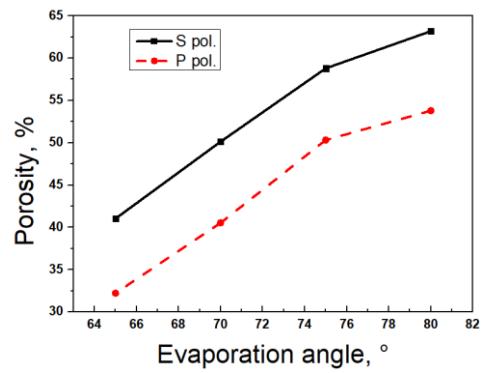
After analyzing results, research studies show that due to the highest refractive index differences, the maximum phase delay in the coating has been achieved at an angle of 70°. That makes this angle most suitable to form a polarizer for 0° of incidence. By combining nanostructured and dense isotropic layers, an optical element with a double Bragg's mirror region can be formed, making these thin films suitable for high-power laser applications.