
During the recent decades, thin film coatings appeared in many fields of industry, including such industries like semiconductors, optoelectronics, optics and even aerospace. Manufacturing of laser optics often take advantage of dielectric layers, which are used for production of high reflection mirrors, antireflective coatings, filters, polarizers, etc. However the production of non polarizing beam splitters, used in various laser experiments, can get very complicated using only the dielectric structure [1]. For this reason, ultrathin metal layers are introduced in the structure, for better performance of the coating. Due to the specific features of metals, interest in ultrathin metal films is growing rapidly among scientist. These films are used not only for production of non polarizing beam splitters [2], but also for development of superlenses [3], for a more detailed imaging, or transparent conductive electrodes, which could be used with applications in solar cells and OLED screens [4].
The research was made on ultrathin copper films. Their optical properties and morphology were evaluated. The dependencies on deposition rate, deposition temperature and film thickness were studied. Optical loss of all samples was calculated from the transmittance and reflectance spectra. Morphology was measured using atomic force microscope. Copper samples were made by electron beam evaporation technology at temperatures from 50 °C to 200 °C, deposition rates from 1 Å/s to 11 Å/s and thicknesses from 6 to 32 nanometers.
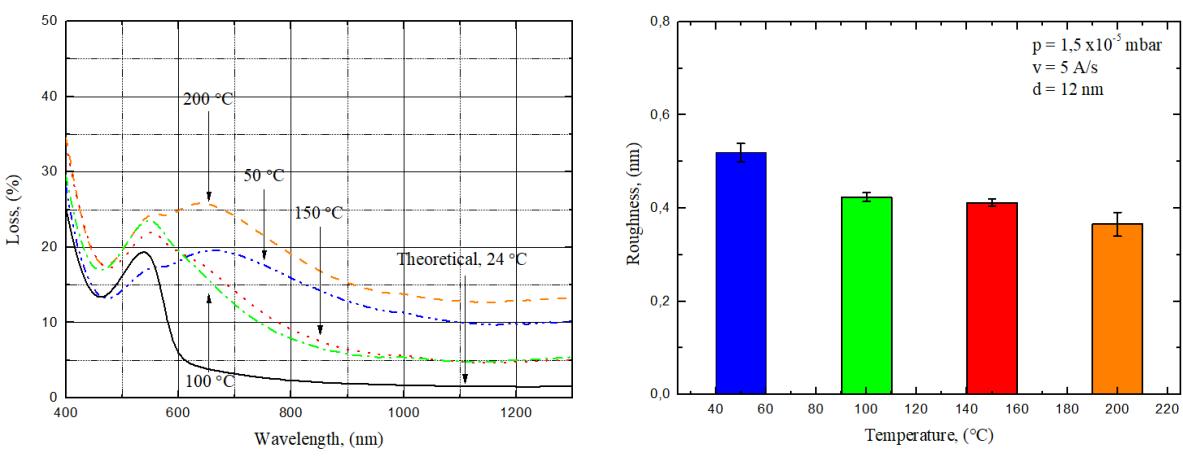
Depending on evaporation process parameters, ultrathin copper films exhibit different optical properties and morphology. It has been shown that, depending on deposition temperature, ultrathin films show different initial stage growth mechanism, therefore some of the samples did not form a continuous metal layer and the absorption of those layers increased substantially (1 pav.).
Dependence on deposition rate of copper material showed that, using higher layer deposition rate results in more dense copper films, which exhibits lower absorption of infrared radiation. At low deposition rate (1 Å/s), continuous film was not observed. In this case, ultrathin copper films grow in form of separated metal islands with gaps between them. Furthermore, these islands interact with electromagnetic radiation and localized surface plasmon (LSP) resonance occurs. During LSP resonance, optical absorbtion in the material can be enhanced by up to 15 %. Increase in layer thickness results in more continuous layer, however surface roughness can be increased drastically near percolation threshold.
Ultrathin copper films exhibit tendencies of their growth mechanisms depending on deposition parameters such as temperature, rate and thickness. This allows to better control continuous copper films for variety of applications.