Three-dimensional laser lithography (3DLL) is applied in the field of photonics. Under certain conditions, 3DLL can be used for photonic crystals [1]; therefore, this could also be applied in the production of phase micro-optical components [2]. Phase micro-optical components are different from other micro-optical elements, because they are move phase modulation devices, also called meta-surfaces. For the production of meta-surfaces such as q-plates, high spatial resolution is essential because components are formed from filaments of lateral linearities smaller than the wavelength of light. 3DLL is still the only technology capable of creating high-resolution (less than 100 nm has been achieved [3]) full-3D structures.
In order to achieve high spatial resolution in 3DLL, it is necessary to select appropriate focusing conditions and to understand the material's response to the laser beam as each material reacts to the light differently. For this reason, suspended bar structures of three materials (SZ2080, SZ2080 + IRG (1%), SZ2080 + DMAEMA) were formed to determine the optimal conditions for high-resolution polymerization and the influence of additives (photoinitiators and quenches) on the dimensions of the bars. The samples were scanned at different speeds (10, 50, 100, 200, 1000 μm/s) to determine which speeds are the most suitable for high spatial resolution fabrication. To perform the 3DLL experiments in this research, a femtosecond laser Pharos (Light Conversion) was used. A Yb:KGW crystal has been used as the laser active element, generating a pulse duration of less than 300 fs, pulse repetition rate of 200 kHz, and the wavelength $\lambda$ = 515 nm. For tight focus, a 60x magnifying lens (Zeiss) with the numerical aperture NA = 1.4 and transmission T = 41 % was used.
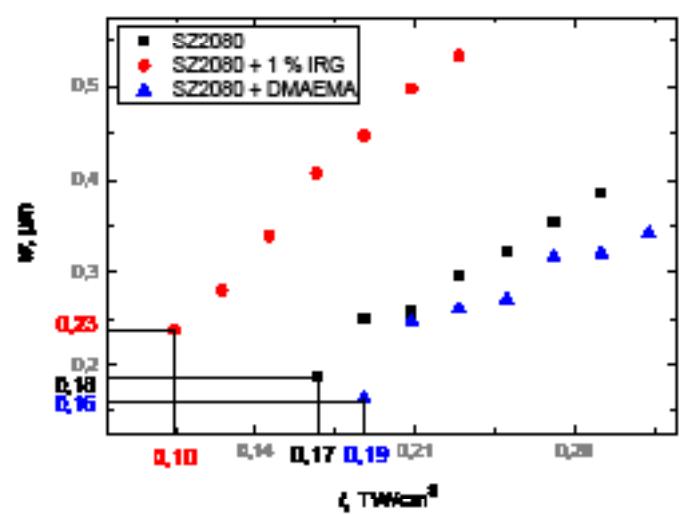
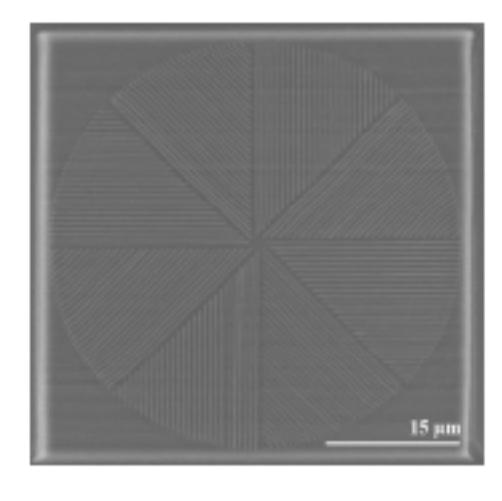
After the research, it was found that the best resolution is achieved by using the additives of the quencher ($d_q = 0.16$ μm/s < $d_p = 0.18$ μm/s < $d_p = 0.22$ μm/s) because their diffusion inhibits the movement of free radicals to areas not affected by laser light [4]. Fabrication of the prepolymer with photoinitiator additives resulted in wider strands because radicals diffuse beyond the beam waist position. The thinnest bars were fabricated at the scanning speed of 200 μm/s, results are shown in Fig. 1. In accordance with the best conditions suggested by the research, a phase micro-optical element, a q-plate with line widths of 0.24 μm, was produced (Fig. 2).