
Light wave with screw dislocation of wave front is referred to as optical vortex. Along the dislocation line in space, the intensity of light is zero and the phase is undefined (singular). Therefore, a beam that carries an optical vortex has a dark core along the dislocation line in space and its wavefront around the core has a helical form with the complex amplitude proportional to exp($il\phi$), where $l$ – topological charge. Due to special intensity and phase distribution, optical orbital angular momentum (OAM) of $l\hbar$ per photon ($\hbar$ is the reduced Planck constant) rises in the light fields carrying optical vortices. Presence of OAM and “doughnut”-shaped intensity distribution made optical vortices useful in various areas: optical communication, trapping and manipulation and astronomy just to name a few [1].
Besides phase singularity, light beam could carry polarization singularities when orientation of major axis of polarization ellipse is undefined. Radially and azimuthally polarized beams are examples of such polarization singularities with topological index $m$ = 1. As it was shown [2], phase front of radially polarized beam also azimuthally modulated. Therefore, question arise, what would be the structure of phase front of a beam carrying both phase and polarization singularities? Note that unlike phase singularity, polarization singularity does not necessary coincide with position of zero intensity.
In this work we track position of singularity upon change of polarization state of a beam. Interferometric methods are, usually, used to detect presence of phase singularities in light fields. Interferogram of optical vortex with a plane wave has a characteristic bifurcation of interference lines (“forked" pattern) centered at the dislocation position. We used a scheme based on a Mach – Zehnder interferometer to detect positions of phase singularities. One arm of interferometer has S-waveplate and quarter wave plate working in tandem. Depending on incoming polarization, S-waveplate generate radially, azimuthally, spirally, circularly or elliptically polarized light. Depending on polarization distribution of generated light beam, position of dislocation appears to be in different places, as shown in (Fig. 1, b), d)). When final polarization state changes from azimuthal through elliptical to circular (Fig. 1, c), d)) positions of bifurcation concentrated along Y axes. When final polarization state changes from radial through spiral to azimuthal (Fig. 1, a), b)) positions of bifurcation distributed all over the beam, including areas of maximum intensity.
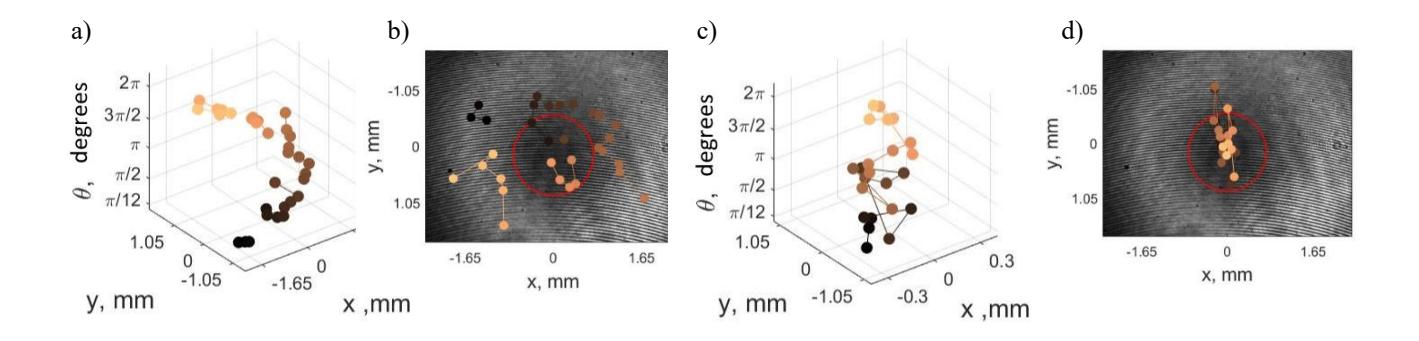
We hypothesize that singularity point localized at the dark core of the vector vortex beam result in ordinary helical wave front of a beam with symmetrically azimuthally distributed orbital angular momentum. However, singularity located at the bright area of the vector beam could result in asymmetric distribution of orbital angular momentum of a cylindrical beam and require further investigation.