Nowadays, energy storage field is becoming more significant. Therefore, when it comes to portable devices, the development of the battery field has an extremely crucial role in it. It has also a huge impact on electric cars industry – especially now, when European Union insists on reducing the level of pollution [1] and many countries introduced subsidies for eco-cars. Moreover, renewable energy sources should be supported by efficient energy storage system. Taking all of these into consideration, the need for electrochemical cells is growing. Essential part of every Li-ion cell is cathode material, so the investigation on new cathode components is becoming more important in energy storage field.
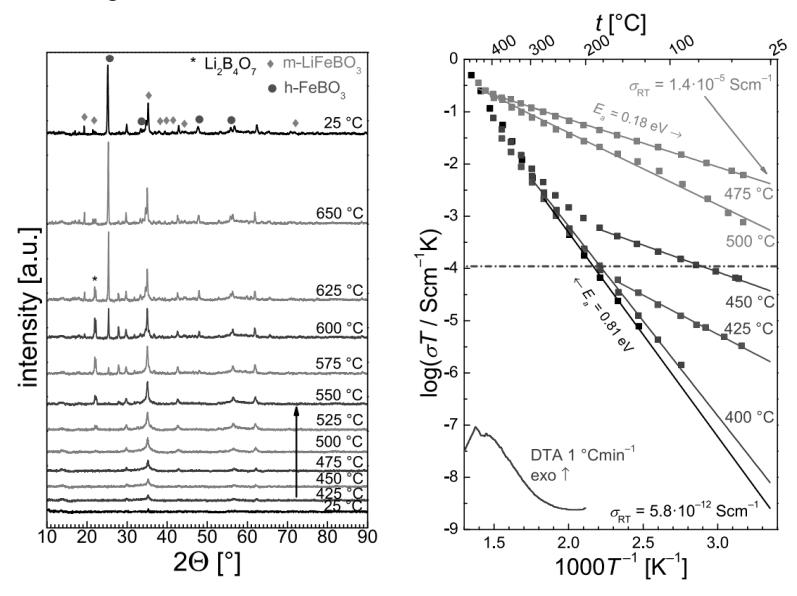
Some time ago, interesting compounds with the composition LiMBO3 (M = Fe, Mn) have emerged as potential cathode materials for Li-ion batteries [2]. Unfortunately, the polycrystalline samples of those materials have exhibited too low conductivity and insufficient practical gravimetric capacity. Herein, we present our recent results of studies on compounds obtained by thermal nanocrystallization of glasses, synthesis of glassy sample and selected physical properties of nanocrystallized analogs. Previously, we have successfully applied this method in case of several glassy systems, e.g. V2O5-P2O5 and Li2O-FeO-V2O5-P2O5. The heat-treated materials exhibited an advantageous microstructure and significantly enhanced electric conductivity (up to 10 orders of magnitude!) [3].
Borates are really good glass-forming materials and are widely used for commercial purposes, such as amorphous optical materials, electrolytes in Li-ion batteries, solid state lasers and have been recently reported to be applied as cathode materials. Lately, LiFeBO3 and LiMnBO3 glassy materials were successfully synthesized and nanocrystallized. Compound with manganese exhibited better glass-forming properties and high increase of electric conductivity after nanocrystallization, but even though, the final conductivity was pretty low. Addition of iron gave better conductivity, but caused lower glass-forming properties. In order to improve conductivity, addition of vanadium was also introduced [4] and LiMn1-3/2xVxBO3 compound was successfully obtained. Another attitude was to use both, manganium and iron – LiFexMn1-xBO3, where x = 0.25, 0.5 and 0.75.
All of the above samples were synthesized using melt-quenching method and characterized with thermal (DTA), structural (XRD, SEM) and electrical (IS) methods. Therefore, this work aims to give better overview on the properties of nanocrystallized lithium-borate glasses.