New applications of laser micromachining are emerging from scientific research and industrial needs, for example, faster and more precise cutting of glasses and other transparent materials or even more exotic field like a production of metasurfaces [1]. All this empowers the search for new ways to improve the industrial process of laser microprocessing.
An increasing number of applications for laser beams with a long focal line, also known as Bessel-Gaussian beams [2], can be easily noticed. Due to their elongated profile they can be perceived as "optical needles" being one of the most prominent member of nondiffracting beams. Another example of the nondiffrating beams is so-called Weber beams [3] that possess parabolic distribution of an electric field in transverse plane. These beams have parabolicity parameter, which provides additional degree of freedom and allows us to control transverse profile - change angle between parabola branches. Furthermore, there is a need within the laser industry not only to change the transverse profile of an optical needle but also to control (engineer) its axial distribution, which is done by superposing many scalar Weber beams [4].
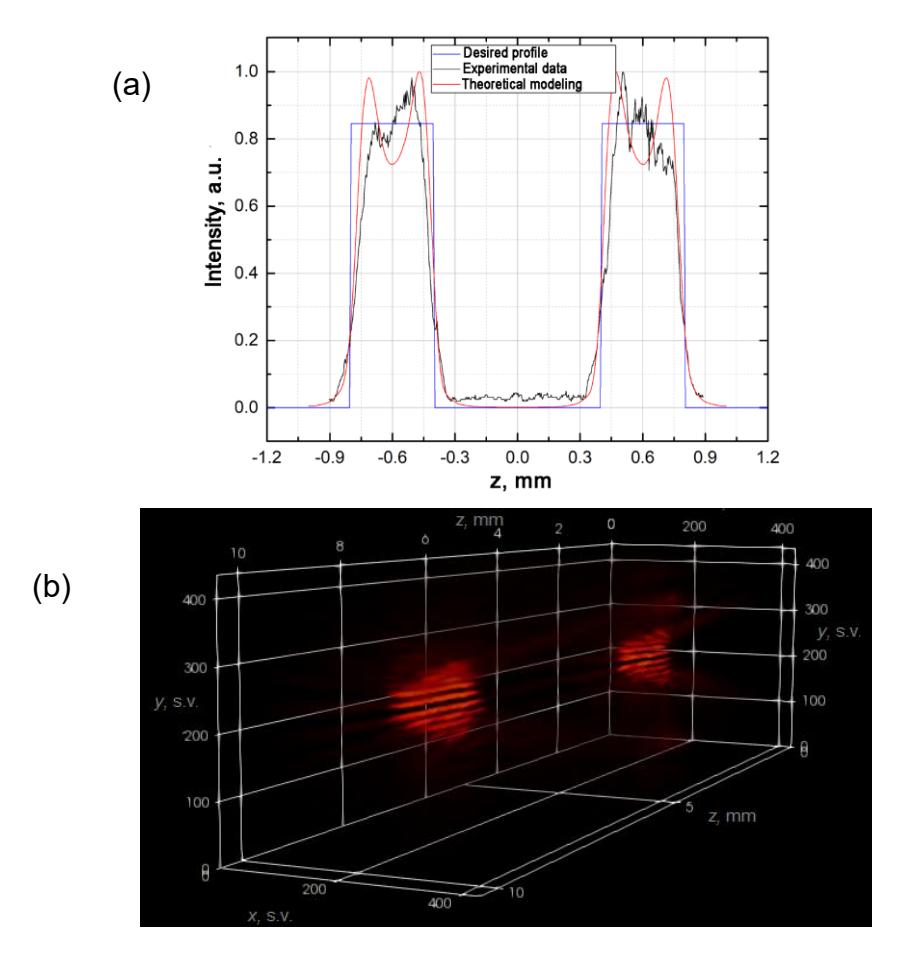
In this work we generate even, odd and traveling Weber beams with initially defined axial intensity profile using phase-only spatial light modulator. We compare experimental results with numerical calculations and analyze the properties of obtained beams. Intensity distribution of Weber beam with axial intensity profile, described as "two steps", is shown in Fig 1 (a,b).