
3H-naphthopyrans are valuable photochromic compounds that have been applied in commercially available photochromic lenses. On the molecular level UV-light irradiation initiates a ring-opening reaction as a consequence of C-O bond cleavage. Two colored isomers: transoid-cis (TC) and transoid-trans (TT) are typically generated. Although the coloration is quite fast, the decoloration process is usually slower which leads to the persistence of a long-lived color for several minutes/hours and this is a serious issue for their application. The photoreaction can be free from residual species simply by replacing a bulky substituent to the 2-position of the naphthopyrans [1]. The application of both, time-resolved electronic and vibrational spectroscopies allows us to detect various intermediates involved in photoreaction of 3H-naphthopyrans [2]. However, transient absorption data analysis and interpretation is not straightforward. Quantum-chemical calculations can facilitate data interpretation by giving predictions for electronic and vibrational transitions related to the species involved in the photoreaction. Herein, parent derivative of 3H-naphthopyran (3,3-diphenyl-3H-naphtho[2,1-b]pyran) and its derivatives with various aryl substituents (phenyl, naphthalenyl and pyrenyl, Fig. 1) at the 2-position were studied. Transient species involved in the photoreaction over time-scale from subpicosecond to hundreds of microseconds were characterized by time-resolved UV-vis and mid-IR optical spectroscopies. Additionally, quantum-chemical calculations were performed with the B3LYP functional, 6-311++G(3df,3pd) basis set (the largest Pople-style basis set) and the polarizable continuum model (PCM) for acetonitrile implemented in Gaussian 09.
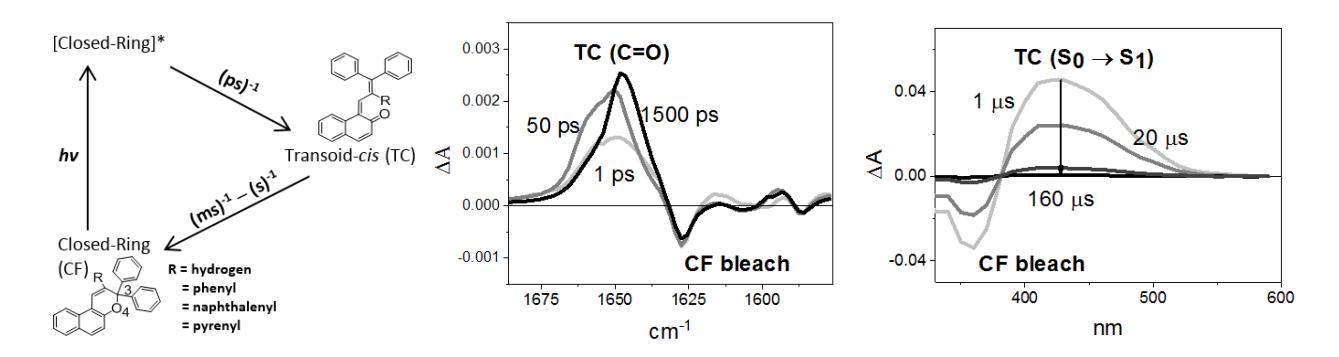
The calculated spectral position (cm-1) of vibrational C=O stretching mode of TC isomers of all studied 3H-naphthopyran derivatives is in a good agreement with experimental data showing positive transient band at about 1645 cm-1. On the basis of TD-DFT calculations it was possible to obtain excitation energies and oscillator strengths of S0→S1 electronic transitions for CF and TC in agreement with experiment too (Table 1).
| R | H | Ph | Np | Py | |||||
|---|---|---|---|---|---|---|---|---|---|
| Absorption | CF | TC | CF | TC | CF | TC | CF | TC | |
| S0→S1 transition [eV] | experiment (*ps, **ns) | 3.44 | 2.93* | 3.42 | 2.88* 2.88** | 3.36 | 2.83* 2.82** | 3.35 | 2.78* 2.82** |
| theory | 3.52 | 2.56 | 3.23 | 2.52 | 3.30 | 2.38 | 2.97 | 2.16 | |
| C = O [cm-1] | experiment | - | 1638 | - | 1648 | - | 1647 | - | 1647 |
| theory | - | 1642 | - | 1638 | - | 1637 | - | 1639 |
In summary, theoretical calculations allow us to assign spectroscopic data to species involved in the photoreaction and mechanistic details of the photochromic reaction can be explored.