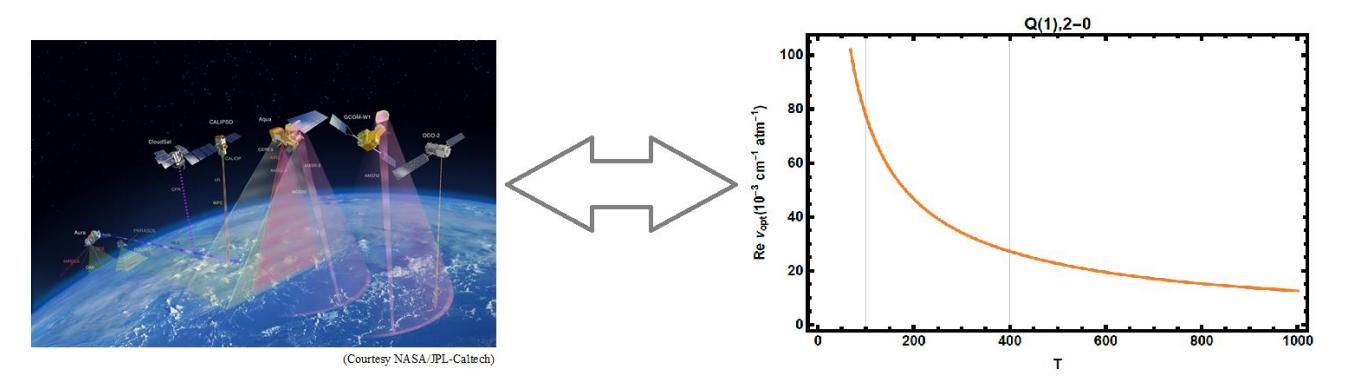
Molecular collisions at microscale are manifested in molecular spectroscopy as a perturbation of the shapes of optical resonances. Analysis of the line shapes constitutes an important tool for studying quantum scattering and testing ab initio molecule-molecule and molecule-atom interactions [1]. A proper treatment of collisional perturbations of the molecular line shapes is necessary for achieving high accuracy in optical metrology, e.g. determination of the Boltzmann constant [2] or exact tests of QED [3]. Furthermore, accuracy of atmospheric measurements of the Earth (e.g. controlling the concentration of greeenhouse gases) and other planets, particullary gas giants, or even opacity of exoplanetary atmospheres requires proper description of the molecular collisional line-shape effects.
To achieve the above goals, recently a new relational structure has been introduced to the most popular line-by-line spectroscopic database HITRAN [4,5], that enables the collisional, beyond-Voight, line-shape effects to be represented properly. It is, however, extremelly challenging to populate the entire database with purely experimental data for enormous ammount of molecular tansitions and thermodynamical conditions (i.e. all the bands, branches, temperature ranges etc.). In my talk I will present the way, the theoretical quantum-scattering calculations are implemented into the flexible structure of modern spectroscopical databases. This approach demonstrated here for the benchmark system of helium-perturbed H2 lines is applicable to many other molecular systems. The results are also validated on the ultra-accurate experimental data of the H2-He system [6].