
Chlorogenic acid, an ester of caffeic and quinic acids, is the most abundant polyphenol that is known to prevent diseases associated with oxidative stress and its related complications. It can exist in the form of three different isomers, namely, i.e. 3-O-caffeoylquinic acid, 5-O-caffeoylquinic acid and 4-O-caffeoylquinic acid [1, 2]. However, the application of caffeoylquinic acid derivatives (CQ) is restricted because of their readily oxidation, low bioavailability, sensitivity to heat and light and high hydrophilicity. In order to overcome these disadvantages those anionic phenolics could be immobilized on cationic polymers such as chitosan (ChS). Nevertheless, the immobilization of pure phenolic acids is expensive and irrational. The appliance of natural extracts instead of pure compounds is more convenient way to achieve desirable results.
In the present study, the formation of water insoluble complexes between ChS and phenolic compounds such as CQ, present in the artichoke extract (AE) has been investigated and the adsorption/desorption of AE on/from ChS has been studied. The Langmuir adsorption model has been used to describe the equilibrium adsorption of AE components from the initial aqueous solution on ChS at different temperatures (Fig. 1).
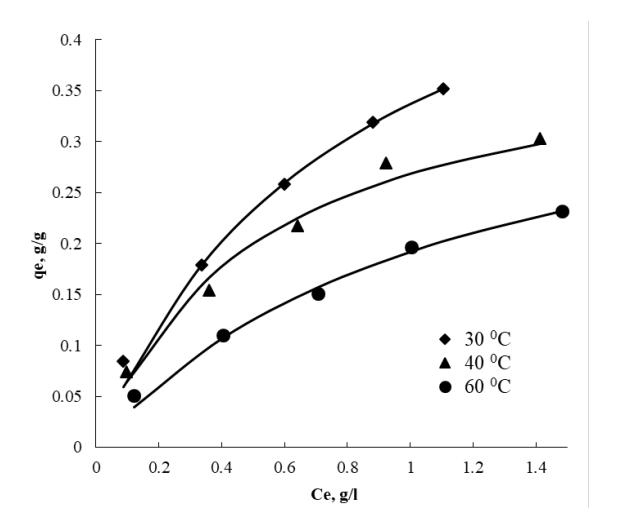
The UPLC and HPLC procedures were used to determine the composition of AE as well as to estimate the amounts of individual components adsorbed on ChS. The chromatographic analysis results clearly proved that not only CQ, but also various other phenolic compounds were adsorbed on ChS.
The antioxidant activity of the formed AE/ChS complexes was studied. It was demonstrated that the immobilization of active components of the natural extract effectively prevented the rapid loss of antioxidant activity over the time.