
Most of vanadium oxides have layered structure, what makes them interesting for potential cathode materials applications. Intercalation is a reversible process of ion inclusion into layered-structured material. Lithium batteries have been examined for 40 years and Li+ plays its role, but today's world needs even better batteries working analogously to Li-ion batteries. Due to fact that deposits of lithium are mostly localized in China, there is substantial need for finding a new replacement for energy storage materials. The idea for replacing lithium in batteries is using sodium [1] or magnesium [2]. Nanocrystallization of glassy analogs of crystalline cathode materials is a very effective method to improve electrical properties of the material, what was proven also in case of vanadate-phosphate glasses. ([3], [4])
MxO-V2O5-P2O5, M = Li, Na, Mg samples were prepared by melt-quenching technique. Weighted chemicals (Li2CO3, Na2CO3, MgO, V2O5, (NH4)H2PO4) were mixed and milled carefully in a mortar and put into alumina crucibles. The precursors were heated at 1300 °C for 30 minutes in an induction furnace. Afterwards, the molten compound was poured onto a stainless-steel plate and rapidly covered with the same one. XRD (X-ray diffractometry) measurements were carried out to identify presence of crystalline phases and to check the amorphousness. Philips X'pert apparatus was used. The analysis of the DSC (differential scanning calorimetry) could give information on glass transition and crystallization temperature, those measurements were carried out by Q200 setup (TA Instruments). The conductivity was improved by thermal nanocrystallization process and its results were presented in Arrhenius plots. The conductivity was measured by DC (Direct Current) and IS (Impedance Spectroscopy) methods. The sample was kept in a tubular furnace Czylok while temperature controller (Eurotherm 2404) was constantly stabilizing. The parameters of the sample (temperature and resistance) were measured by thermocouple, Adam 4011 and Keithley 2001.
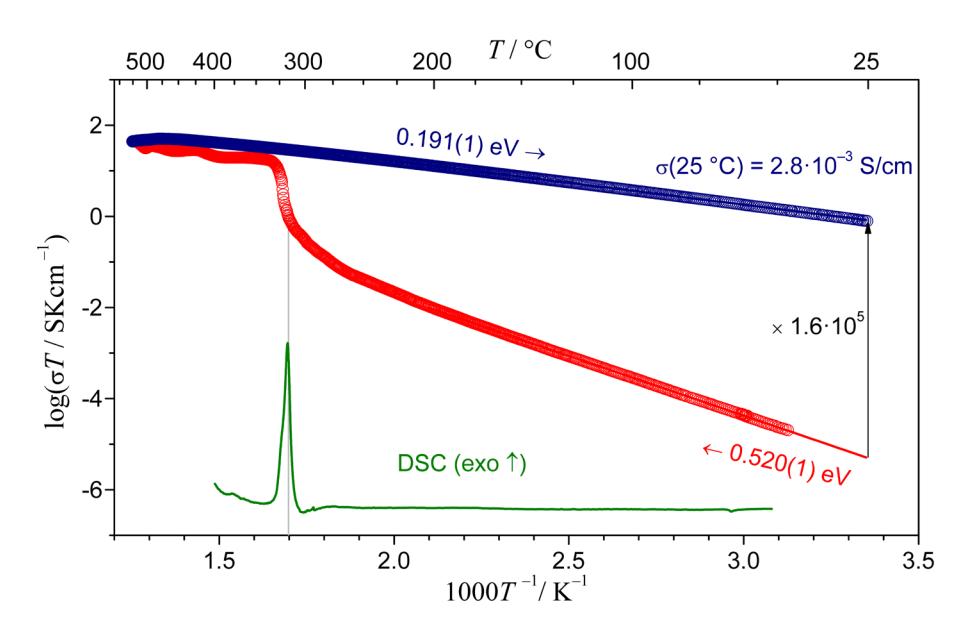
An example of conductivity dependencies in the sample as function of a temperature is presented in Arrhenius plot. The plot consists of two ramps: heating (red points) ramp and cooling one (blue points). The nanocrystallization process included heating up to 515 °C. As expected, due to nanocrystallization process, the conductivity increased irreversibly. In the future, there are plans to carry out the electrochemical measurements of L, N, M samples.