
Thin multilayer coatings based on nitrides of transitional metals (TM) are widely used as hard protective coatings in the industry for hardening of the cutting instruments, punches, the frictional surfaces of the machine parts and so on.
One of the most important properties of the coatings for their practical application in many fields of the industry is their resistance to harsh environments exposure, in particular, to high temperature oxidation, influence of corrosive medium (for example, saline or acid solutions) and ion irradiation damage.
One of the promising approach of both improvement of mechanical characteristics and increase in a resistance to high-temperature oxidation is the formation of multilayered film structures. Multilayers consisting of alternate stacking of TM nitride and SiNx layers are characterized by very low intermixing that promotes their thermal stability and oxidation resistance.
CrN/SiNx multilayer coatings with different thickness of CrN and SiNx layers were deposited on (001) Si substrate by a reactive magnetron sputtering under Ar + N2 plasma discharges at the temperatures of 300-450°C. Multilayer coatings were synthesized via sequential sputtering from elemental Cr and Si3N4 targets.
According to transmission electron microscopy (TEM) and X-ray diffraction (XRD) analysis the multilayer coating consist of nanocrystalline (200)-oriented CrN and amorphous SiNx layers. Reducing the CrN layer thickness fraction with respect to bilayer thickness leads to decrease in crystallite size and increase in the lattice parameter of CrN phase due to higher compressive stress.
The oxidation resistance under air using in situ XRD, in the temperature range from 400 to 950°C was studied, as well as by WDS and SEM methods after air annealing procedure. Fig. 1 shows XRD analysis results of CrN/SiNx nanostructured multilayer coating and CrN monolayer coating.
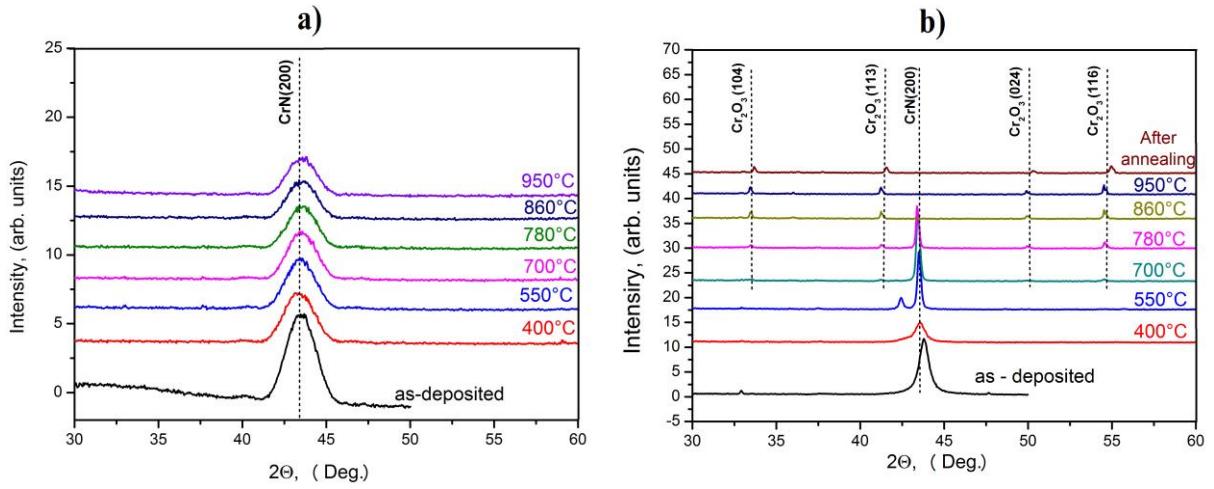
According to XRD analysis results, CrN/SiNx nanostructured multilayer coating possess a greater thermal stability then CrN monolayer coating. Fig. 1 b) shows that the chromium oxide begins to form at a temperature of about 700°C, but in case of multilayer coatings, oxides at a temperature of 950°C weren't detected.