
Significant efforts have been made all over the world to create TW-class laser systems [1] that take up a lot of space, while development and maintenance costs limit their distribution. Therefore, such systems are usually shared by many scientists with limited access time. For the wide distribution of high peak power lasers among the scientific community, it is vitally important to pay special attention to reducing the size and cost. We report on the current state of development of a cost-effective and compact pumping source for TW-class Optical Parametric Chirped Pulse Amplifier (OPCPA) containing a fiber seed laser, a pulse picker, a two-cascaded double-pass Chirped Pulse Amplifier (CPA) based on Yb:YAG rods and a pulse compressor. With a scalable output of 20 - 60 mJ and a pulsewidth of ~ 1 ps at a repetition rate of 100 Hz, the experimental setup includes commercially available components and is easily reproduced.
A two-stage double-pass CPA operates at a repetition rate of 100 Hz [2,3]. Seed pulses were selected using a Pockels cell with an extinction ratio of over 30 dB from a fiber laser operating at 10 kHz. The first CPA cascade is based on $2 \times 2 \times 20$ mm3, 2% at. Yb:YAG rod pumped by ~ 7 ms pulses, emitted from the high brightness laser diode. The induced thermal lens was compensated by adjusting the distance between the spherical mirror and the laser rod. Faraday rotators, located after the first pass of Yb:YAG CPA stages, suppress the depolarization. Pulses with an output energy of up to 2 mJ, a pulsewidth of ~ 150 ps and a spectral width of ~ 1.8 nm were directed to a second CPA cascade designed to achieve an output energy of several tens of mJ. To reduce the incident energy density, the input beam was expanded to ~ 1.5 mm. Larger aperture: $5 \times 5 \times 20$ mm3 rod with 2 % at. Yb-doping was pumped by a combined output of seven laser diodes providing pulses of ~ 2 ms with a total average power of ~ 90 W at a repetition rate of 100 Hz. Spatial beam cleaning with an insignificant energy loss of < 6 % eliminates the impact of spherical aberration (Fig.1, left).
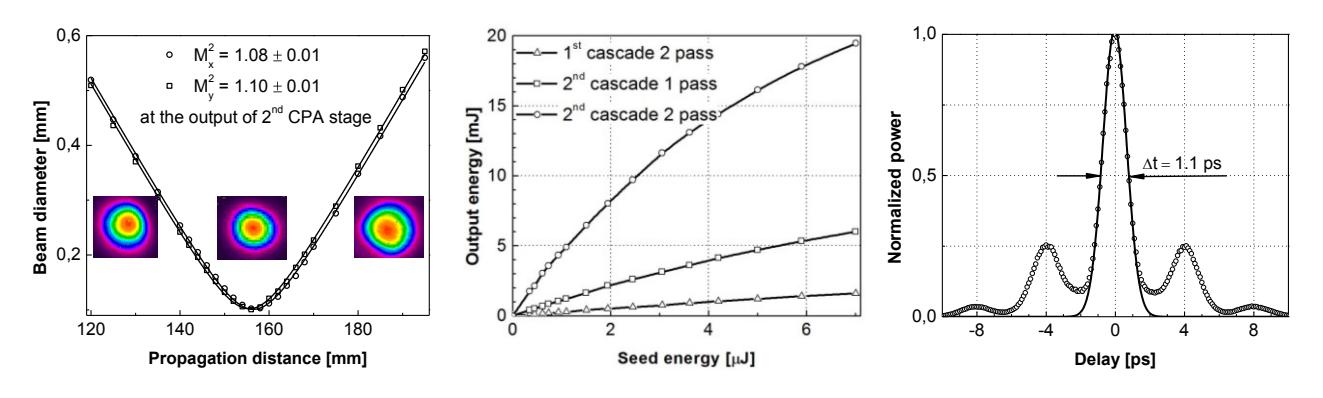
Amplified pulses with a total gain of ~ 2800, an output energy of ~ 20 mJ (Fig. 1, middle) and an excellent beam quality of M2 ~ 1.1 (Fig. 1, left), pulsewidth of ~ 90 ps and spectral width of ~ 1.6 nm were directed to a compact folded compressor based on a diffraction grating of 1842 grooves/mm and a diffraction efficiency of more than 97 %. Although the gain narrowing to a spectral width ~ 1.6 nm FWHM after amplification, we obtained pulses of ~ 1.1 ps (Fig. 1, right), 1.1 times of transform limited for measured bandwidth. The overall efficiency of a 4-pass compressor exceeds 90 %. Combining of 19 pcs of pumping diodes with the commercially available fiber beam combiner enable an increase in the output energy to ~ 60 mJ. The optimization of the temperature gradient applied to the fiber stretcher in the seed source is ongoing to improve the temporal contrast of the compressed pulses. Output pulses converted to the second harmonics at 515 nm wavelength in an LBO crystal are used for pumping of 1 TW-class OPCPA.