
Recently there has been growing interest in plastics research. Because of the excellent chemical and physical properties plastics are used in many fields. Polypropylene (PP) is one of the most extensively used polymer as it exhibits excellent chemical resistance, high tensile strength and low density. In order to improve the properties of the plastics, during the manufacture process, additives such as plasticizers, stabilizers, antioxidants, pigments and other are required to be added. However, all the additives can migrate from the plastics into the food and contaminate it during production or storage.
An objective of this study was to investigate commercial PP packages in order to find out what kind of additives are used most often to manufacture the packages. The PP samples (films for food packaging, candy trays, food preservation bags, plastic jars and etc.) were analyzed by thermal desorption GC/MS. Approximately 0.1 g of PP that was cut in to small pieces was inserted into a glass thermal desorption tube. Plugs of glass wool were inserted into the thermal desorption tubes to hold the PP material in the tube. The tubes were sealed with caps made of Teflon, loaded into autosampler and analysed.
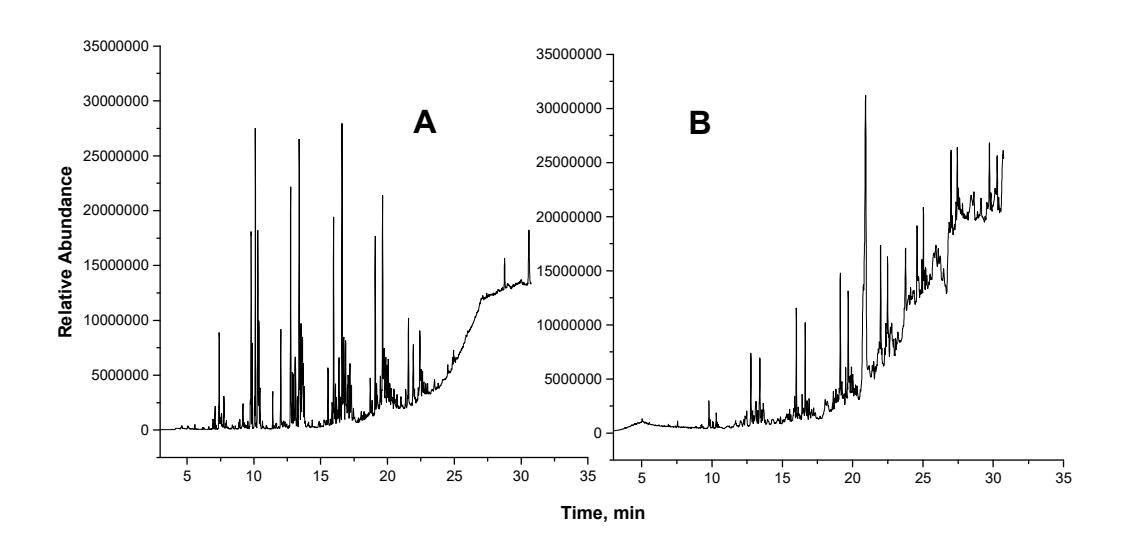
In order to compare the difference between the colored PP packages, it was chosen to analyze light and dark colored packages. Figure 1 shows clear difference between GC-MS chromatograms of different colored PP packages. The potential migrants were identified using NIST MS Search 2.0 spectra library and were sorted by groups of compound classes such as acids, alcohols, aldehydes, halogenated compounds, hydrocarbons and etc. The most striking result to emerge from the data comparison was that dark colored PP packages release more migrants than light colored PP packages, but it seems that the main migrants are the same. The reason for this is not clear yet but it might be related to the pigments that are used during the manufacture process of dark plastic packages.
However, more research on this topic needs to be undertaken before the association between the migrants and their source of origin could be more clearly understood.