
3-axis positioners are used for objects moving or positioning with high accuracy and can be applied in various fields of applications, for example, machining equipment 3D printers or scanning probe microscopies [1]. For mechanical part of 3D positioning system in scanning probe microscopies, main requirement is positioning accuracy. In similar systems x and y axes have positioning accuracy of 1-3 μm and these two axes are driven by stepper motors. Z axe usually have dual actuators: piezo or electromagnetic for accurate positioning, and stepper motor for coarse positioning and achieves positioning accuracy less than 1 μm [1,2]. Movements of x and y axes are used for scanning point-by-point in the user defined matrix close to surface of interest. The result could be chemical reactivity of the sample (in scanning electrochemical microscope) [1,2], topography (in atomic force microscopy) [3], conductivity (scanning electrochemical impedance microscopy), magnetic properties, etc. The possibility to determine these properties depend on probe's type and on other related equipment. The main problem in this kind of microscopies is positioning of the z-axis. Some of the microscopes can work only in constant-height mode rather than constant-distance. Constant-height mode means that probe is positioned at some distance from surface, and when the probe is moved in x and y axis, z position is constant. Some practical solution of this problem could be controlling of z position by measured signal. However, this method is not accurate and can led to probe crash or surface damage. Also, the goal to determine how the measured signal changes at the same distance from surface, cannot be achieved, since the control system tries to move electrode to the position, where signal is the same - so, the distance is not constant. To work in constant-distance mode, the z axis should be controlled independently on signal from surface of interest, but using another signal for control, for example, shear-force or atomic force microscopy control method. Shear-force method can only be applied when small probes, nanometers in diameter, are used. Two piezo plates are attached to the body of the probe. One piezo plate excites nanoneedle at the frequency, close to resonance, and another plate will measure the response frequency. Atomic force microscopy positioning is based on cantilever's deflection, detected by optical system. The problem in this system is that the fabrication of nano diameter probe is difficult. Therefore, the positioning control systems are based on well-known mechanical principles, and should be designed by mechanical engineers.
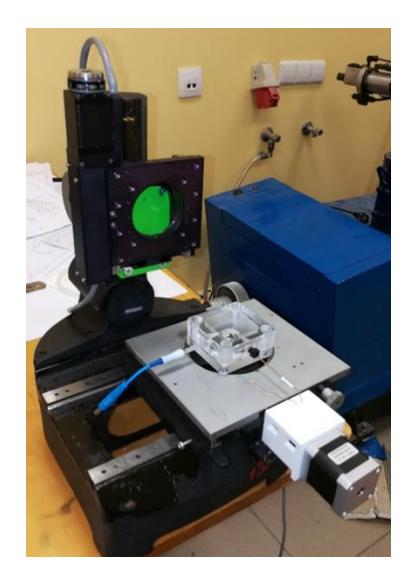
The designed 3-axis positioner should meet three requirements: speed, accuracy, and force. The most important parameter is accuracy, when positioner is devoted to positioning of scanning probe. The chosen stepper motors with precise ball screw drives and suitable control system could achieve positioning accuracy of 2.5 μm in x and y axes. It is enough for scanning of biological objects, since it is possible to form a spot with 50 μm diameter and probe (for example, microelectrode) is of 5-10 μm diameter. Chosen drive system, stepper motor and ballscrew are more reliable, less expensive and easy applicable to different needs in comparison with piezo drives or linear motors.