Electrochromic materials (ECMs) possess the ability to change their optical properties as reversible responses through the alternation of the applied potential or current. ECMs are employed in numerous practical applications, such as electronic paper, smart windows and optical memory devices [1]. In most cases, the inorganic oxides based on W, Mo, Ir or Ni are used [2]. Organic ECMs have unique advantages over their inorganic counterparts, which include fast response time, flexible device fabrication, a relatively narrow absorption band in displaying diverse and clear colours and large-scale processability [1].
In the present study different type small organic molecules were investigated as active materials in electrochromic devices (ECD). The changes of structure during the device performance were investigated employing Raman scattering (inVia, 532 nm, Renishaw, UK) and FTIR (Vertex 70, Bruker, Germany) spectroscopies. The change of transmittance under the impact of applied voltage was registered using UV/VIS spectrometer. The ECD containing ion-conducting liquid with active organic material was sandwiched between two electrode surfaces using a spacer of ~1 mm. An indium tin oxide (ITO)-coated glass/PET (Solaronix, Switzerland) was used as electrodes in the device. The electrolyte solution was prepared by dissolving organic molecules (10-3 M) and tetrabutylammonium hexafluorophosphate TBAPF6 (0.1M) in acetonitrile. Then, electrolyte was injected into the electrochromic device with the use of a syringe.
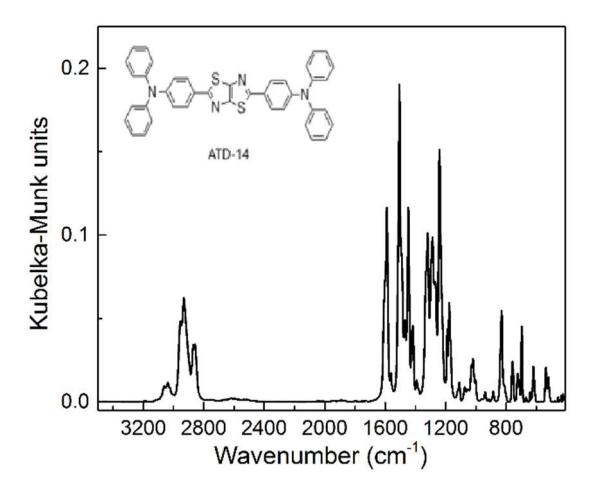
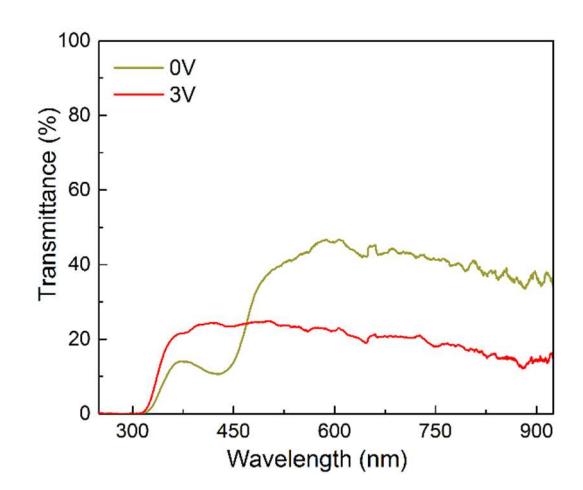
The FTIR spectrum of starting material in powder form is presented in Fig. 1. The inset in Fig. 1 shows the chemical structure of the compound used in ECD. The investigated compound was dissolved in acetonitrile with TBAPF6 and injected between two ITO-glass electrodes. At the starting point (no applied voltage), the absorption around 440 nm was observed as shown in Fig. 2. The influence of the applied voltage on the transmittance of the system was tested. It was shown that under the applied voltage of 3 V the absorption peak at 440 nm disappeared, and the overall transmittance of the sample decreased.