
Noble metal nanocrystals exhibit rich surface plasmon resonance properties. This effect gives metal nanoparticles a number of unusual useful optical properties, that can be applied in many fields, such as surface enhanced Raman spectroscopy [1], metal enhanced fluorescence spectroscopy [2], optical biosensors, optoelectronics etc.
Due to the interesting influence of metal nanoparticles on spectroscopic properties of nearby organic molecules, the metal nanoparticle – organic molecule systems have been widely investigated, manly focusing on the plasmon-induced fluorescence enhancement. Another effect, molecule fluorescence quenching by resonance excitation energy transfer to metal nanoparticles, was also widely investigated. On the other hand, much less is known about opposite energy transfer from photoexcited nanoparticle to organic molecules. Very short excited state lifetimes of metal nanoparticles and a lack of Stokes shift make this process inefficient and difficult for experimental investigation. Wang et al. have recently reported blue-shifted molecular fluorescence created by the plasmon-induced resonance energy transfer [3].
In our work we investigate the resonance energy transfer from silver nanoparticles to organic dye DODCI molecules. Spherical silver nanoparticles were formed using thermal evaporation and annealing method. Organic dye DODCI was used as an energy acceptor.
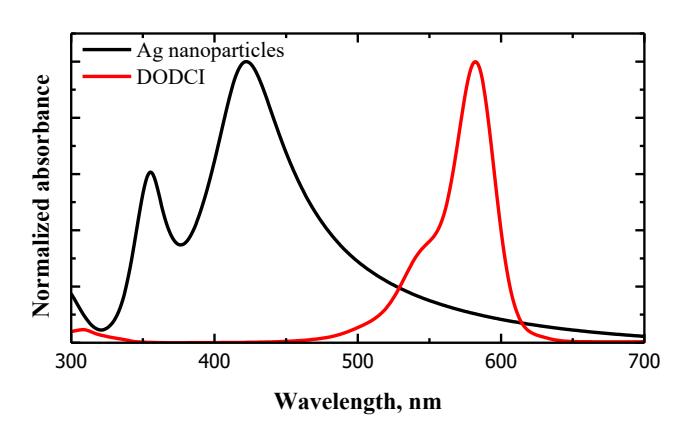
Measured fluorescence excitation spectrum of DODCI molecules adsorbed on silver nanoparticles showed resonance energy transfer from silver nanoparticles to DODCI molecules. DODCI fluorescence has been observed under excitation of the nanoparticle-dye system to the plasmon resonance band located at the short wavelength side from the dye absorption band where dye absorbance was negligible.