
Caffeic acid (CA), a phenolic acid present in numerous dietary plants, was shown to exhibit antioxidant, anti-inflammatory, and anticancer activities [1]. Being hydroxycinnamic acid derivative CA has a high antioxidant activity due to the presence of conjugated double bonds in the side chain. However, the presence of unsaturated bonds in the molecule also determines the instability of CA. Different methods are used to protect bioactive phenolic compounds from oxidative damage. One of them is the formation of complexes with natural polysaccharides, such as chitosan (CH). In acidic medium CH amino groups are protonated, and can form ionic complexes with negatively charged compounds.
The purpose of the present investigation was to evaluate the equilibrium adsorption of CA onto CH microgranules at different temperatures, as well as to assess the antioxidant properties of obtained complexes.
In the adsorption study aqueous CA solution at pH equal to 3.20 ± 0.1 was poured over CH microgranules, flask was stoppered and shaken for 120 min at different temperatures. Then the mixture was filtered through a paper filter, and UV absorbance intensity of the filtrate at λmax=316 nm was measured for the determination of CA concentration by using calibration curve.
The obtained adsorption isotherms of CA onto CH at different temperatures are presented in Fig. 1, and show that amount of adsorbed CA decreased with an increase of the adsorption temperature. The mathematical adsorption models have been used to assess the adsorption data, and the thermodynamic characteristics have been determined.
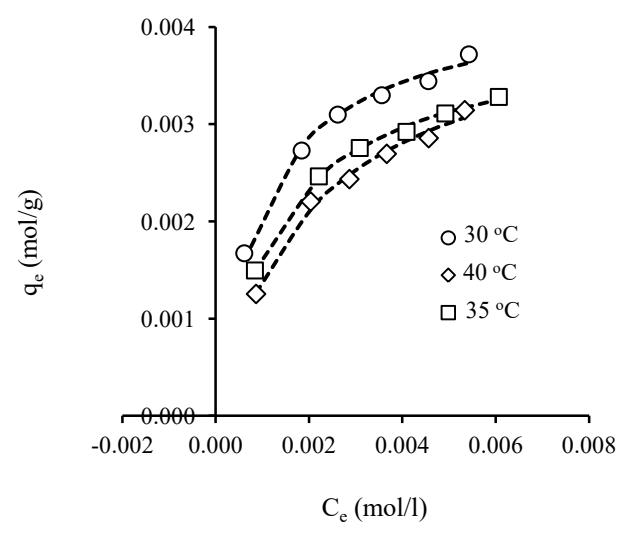
Analysis of the Langmuir, Freundlich, Dubinin-Radushkevich and Temkin adsorption models parameters demonstrated that CA is adsorbed on the ionized amino groups of CH due to electrostatic interactions between the latter groups and the carboxylic group of CA. Adsorption proceeded moderately difficult and the physical forces also played a role in the adsorption process. Analysis of thermodynamic parameters of adsorption showed that CA adsorption on CH was spontaneous. However, the negative values of changes in Gibbs free energy decreased with an increase of adsorption temperature. The negative values of the changes of enthalpy and entropy implied that adsorption was endothermic process, and the order of systems during the course of adsorption increased.
The adsorption of CA onto CH microgranules was confirmed by FT-IR spectroscopy. Desorption of CA from CA-CH microgranules as well as antioxidant activity of complexes were also investigated.