
Metal-organic frameworks (MOF) are hybrid coordination polymers with an open pore system [1]. These coordination networks are formed from the various organic linker molecules and metal centers. The application areas of these highly porous compounds range from the biological imaging to gas storage and separation.
In this work we performed X-band continuous-wave (CW) EPR experiments on MOFs containing different ratio of the paramagnetic radical and diamagnetic linkers. In addition, the investigated compounds consists of so called Cu/Cu dinuclear paddle-wheel (PW) units that are responsible for rich magnetic properties of these materials.
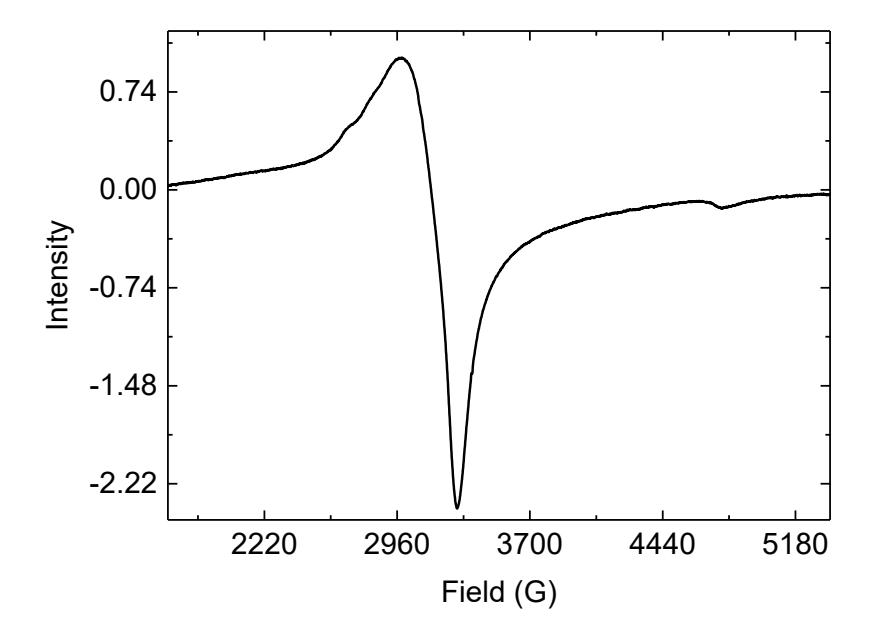
The observed CW EPR spectra are typical for the Cu/Cu PW units with a pronounced inter PW exchange interaction of spin $S = 1$ states (see Fig. 1) [2]. In addition, a signal of Cu2+ defect sites can be observed. A small free radical signal was detected only for the compound with 100% of the radical linker. Measurements at different temperatures demonstrate that decreasing temperature signal from intra PW exchange decreases only for the same material.