
Hydration plays a fundamental role in maintaining the three-dimensional structure and function of proteins. In this study, Raman spectroscopy was used to probe the hydration induced structural changes at various sites of lysozyme (lyz) under isothermal conditions in the range of water contents from 0 to 44 wt %. Raman hydration curves were constructed from detailed analysis of marker bands. Transition inflection points ($w_m$) and onsets determined from the hydration curves have shown that structural changes start at 7-10 and end at about 35 wt% water. The onset of structural changes coincides with the onset of the broad glass transition earlier observed in this system. The increase of $\alpha$-helix content starts at very low concentrations of water with $w_m$ = 12 wt %. Monitoring the development of importance for enzymatic action hydrophobic clusters has revealed $w_m$= 15 wt % and completion of the process at 25 wt %. The parameters of 621 cm-1 (Phe) and 1448 cm-1 (CH2 bending) modes were found to be sensitive to hydration, suggesting changes in organization of water molecules near the protein surface [1].
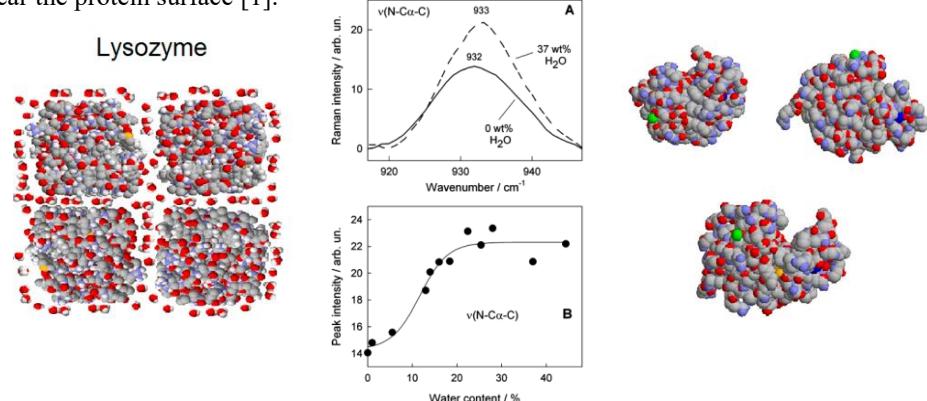
According to simulations by Donev et al. [2] the volume fraction of packed prolate spheroids with aspect ratio 5:3 is about 0.715. In other words, the minimum theoretical water content needed for existence of native structure in lyz is 28.5 vol % or 22 wt% assuming a density of lyz of 1.4 g/cm3 [3]. In reality, the minimum water content should be higher because we expect at least one layer of water molecules to be present at the interface between lyz molecules. This leads to the following ratio:
$$\frac{V_W}{V_L + V_{BW}} = \frac{0.285}{0.715} \tag{1}$$where VW, VL, and VBW are volumes of free water, lyz, and bound water, respectively.
Calculations of the area and the volume of a prolate spheroid based on approximate dimensions of lyz molecules of 5 $\times$ 3 nm give 4150 Å2 and 23560 Å3, respectively. Assuming that a half of a water molecule belongs to every lyz molecule at the "touching" interface, the volume of the bound water is 6225 Å3, which gives the volume of free water of 11 870 Å3. Finally, the water to lyz ratio is calculated as:
$$h = \frac{V_W + V_{BW}}{d_L V_L} \tag{2}$$Using a density of native lyz dL of about 1.4 g/cm3 [2] one arrives at an h value of 0.55 or 35 wt% water. Thus, from simple geometrical considerations, at about 35 wt% water, one can expect formation of the native structure of lyz. At water contents above 35 wt%, dehydration does not change the lyz structure and only removal of water occurs. Below 35 wt%, water dehydration has an effect on the structure of lyz because further removal of water cannot happen without geometrical distortion of lyz molecules.