Considering the promising alternative of X-rays generation by plasma accelerated ultrafast electrons [1], in this work we investigate electrons acceleration in a laser pulse generated plasma. As the main tool of research in this area, we consider electron energy spectrum, as a result we will pay attention for electron energy distribution dependencies on laser parameters in more detail.
To begin with, there were foreseen to model a physical system of electrons acceleration. In addition, some theoretical assumptions were made. Firstly, here we describe a single electron, which is initially at rest. Then electron starts to oscillate in high intensity fields of an electromagnetic wave with a random initial phase (from 0 to $\pi$). As we will see, random phase in the beginning of oscillations provides results, which describe multiple electron systems. It is important to mention, that we do not consider the interaction between electrons and ions, nor take into account the frequency distribution of laser pulse.
Second task was the implementation of the physical system in the “Matlab” environment. During the modeling part, the system was set to original parameters, used for a calibration of the model: the laser intensity was 3$\times$1018 W/cm2, the wavelength of 800 nm and pulse duration of 120 fs. Later, these parameters were varied in order to find out dependencies of the spectrum.
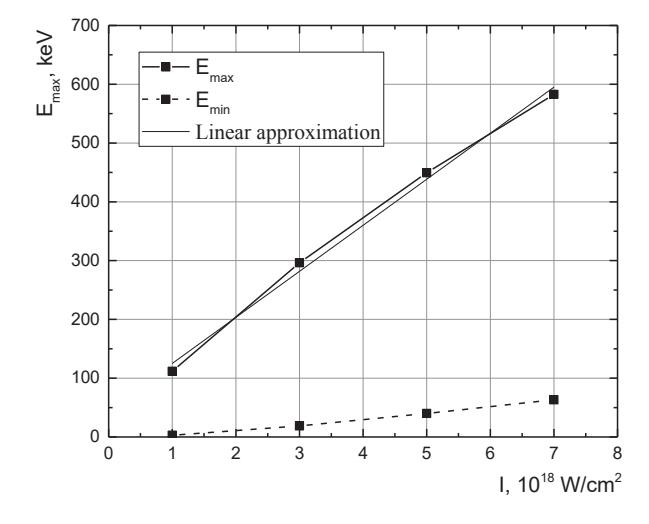
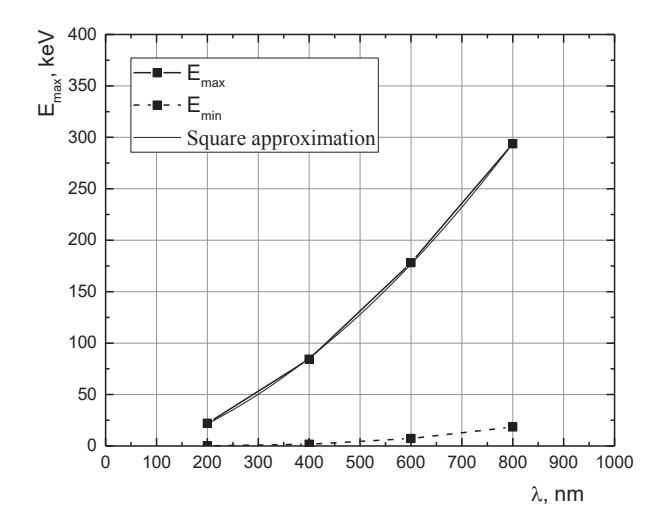
Final part involved the generation of electrons spectrums by using the created model and analysis of the energy distributions. A set of spectrums were got, which had similar properties as experimental results during electrons acceleration in plasma [2][3]. Considering this fact, we made a conclusion that our generated spectrums could be considered as a suitable approximation for experimental data. The analysis of main results showed the electron spectrum evolution in the first period, the linear dependency on a laser intensity (Fig. 1) and the square dependency on a wavelength (Fig. 2).