
Formation of plasma membrane is considered as a crucial event during evolution and life, as known today, would not be possible without them. Actual plasma membranes contain a complex, heterogeneous distribution of lipids and membrane proteins which interact to create important biological functions. To investigate this complex membrane environment significant progress has been made to model native membranes. The most common systems include lipid monolayers, lipid vesicles, and supported lipid bilayers (SLBs) [1]. Particular group of solid supported bilayers, tethered bilayers (tBLMs), are considered as perspective experimental platforms for membrane biosensors [2]. In particular, the modulation of the ionic conductance of tBLMs may be utilized to develop biosensors of the membrane damaging agents such as pore-forming toxins [3].
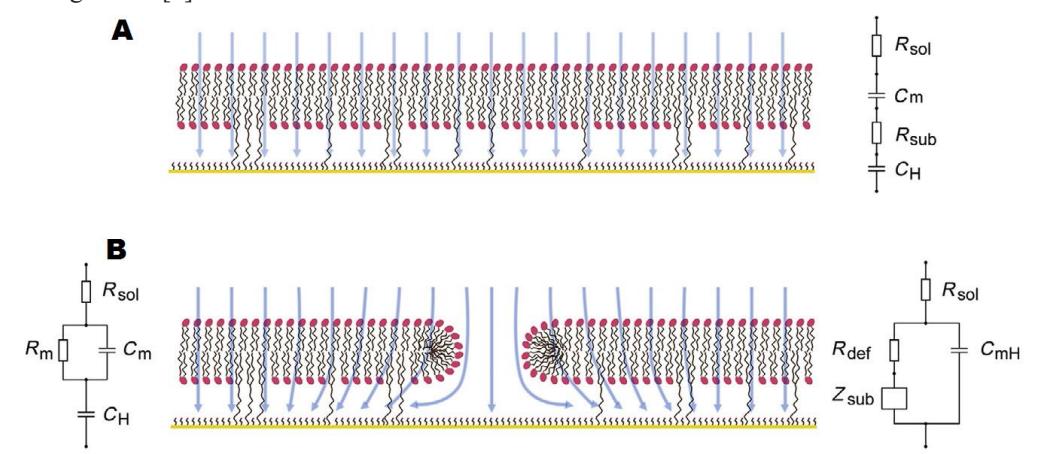
We have used the tBLM platform for the detection and visualization of cholesterol-dependent cytolysins (CDCs), using electrochemical impedance spectroscopy (EIS) and atomic force microscopy (AFM) techniques. tBLM modification in aqueous environment has been performed, using Methyl-β-cyclodextrin (MβCD) and cholesterol complex, to achieve picomolar CDC sensitivity.