Increasing demand for the organic light emitting diodes (OLEDs) in commercial applications could be associated with the demonstration of novel and attractive photophysical and mechanical properties such as flexibility, tunable fluorescence emission and cheap large area device production. Recently, organic compounds displaying thermally activated delayed fluorescence (TADF) attracted great attention because this class of compounds can harvest both singlet and triplet excited states for luminescence [1]. Although TADF OLEDs exhibit superior performance in the blue and green region the design and synthesis of highly efficient red and near-infrared (NIR) organic TADF materials still remains a great challenge. Furthermore, red and NIR emitting OLEDs offer wide applications in night-vision, telecommunications, sensors and bioimaging [2].
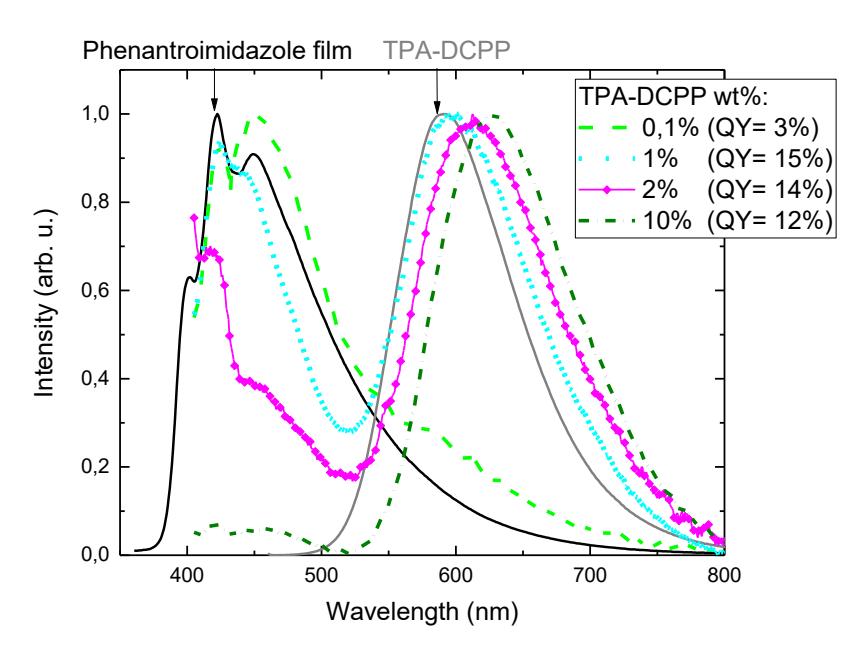
The current work focused on optical and photophysical investigation of phenanthroimidazole derivatives containing various functional groups (phenothiazine, indole, carbazole, triphenylamine). Detailed photophysical measurements were carried out to show that studied compounds exhibited deep ultraviolet absorption (from 329 to 388 nm) and blue-cyan fluorescence (FL) emission (from 410 to 500 nm). Due to the wide band gap and favourable FL emission, the phenanthroimidazole compounds were investigated as a host for energy transfer. Fluorescence energy transfer rate (FRET) was evaluated for efficient red TADF emitter TPA-DCPP (guest). Highest theoretical FRET values were obtained for phenanthroimidazole compounds containing phenothiazine and carbazole fragments. These two host were experimentally examined and compared with commercially-available TPBi host widely used in OLEDs. Guest-host blends were fabricated for different hosts with different TPA-DCPP concentrations (0,1 -10 wt%). Although in theory the compound with phenothiazine fragment exhibited higher FRET rate than a molecule with carbazole moiety, experimentally the later outperformed phenothiazine-phenanthroimidazole compound. The fragment of carbazole between the phenanthroimidazole derivatives provided effective FRET at high levels of TPA-DCPP concentration (10%), and at this point demonstrated superior energy transfer properties compared to well-known TPBi matrix.