Lately, there has been an increasing need for traditional solvent substitutes, which would be environmentally friendly. For this reason, ionic liquids are of great interest and could be excellent alternative to traditional organic solvents used in industry [1]. The variation of the ionic liquids parameters, as a relatively new class of solvents, provides an opportunity to adapt them to the various chemical processes. The chemical and physical properties could be determined by their structural changes which occurs during the interactions with water molecules. The dependence of the structural transformations of ionic liquids on temperature and pressure has been sufficiently studied by vibrational spectrometry and other methods [1-5].
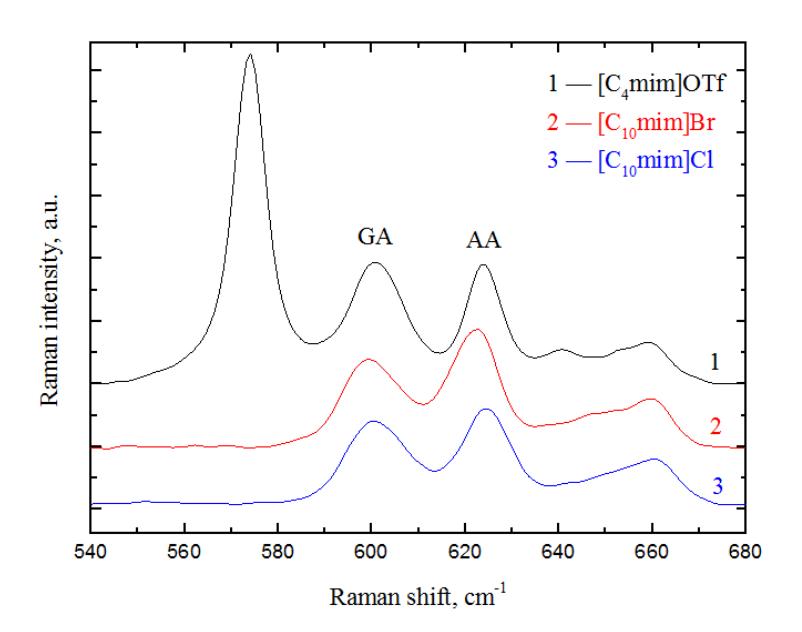
In the literature there are not so many investigations on conformational equilibrium variations depending on the water content in the system. The aim of this work is to study the structural changes and interactions of three ionic liquids - [C4mim]OTf, [C10mim]Br, [C10mim]Cl with water molecules while changing the concentration of H2O in the mixture. The very sensitive method for the monitoring of molecules conformational changes is vibrational spectrometry. It could provide very detailed information of the molecular structures either in neat ionic liquids or in the mixtures with other solvents [2-3]. Raman spectra of ionic liquids and water mixtures in the region 200-3600 cm-1 have been registered while water molar ratio in mixtures was changed from $X_{\rm W} = 0.05$ to $X_{\rm W} = 0.095$. The ratio of integral intensities $I_{gauche}/I_{anti}$ of corresponding spectral bands of the gauche and the anti conformers were investigatred (Fig. 1). It was found that the intensity ratio $I_{gauche}/I_{anti}$ is changing with the added water for all studied mixtures, the ammount of mollecules in gauche conformation increasing. Another insight to the results could be done when analyzing the ratio of the gauche and the anti conformers at the low water concentrations. The [C4mim]OTf has more molecules which formed gauche conformers than anti and [C10mim]Br, [C10mim]Cl showed the opposite results.