
Acetylacetone (AA) molecule is interesting due to the intramolecular H-bond formation as well as proton tunneling. To study the effect of halogen substitution on H-bond strength were performed calculations of the equilibrium structures and IR spectra of the next few molecules, represented on Fig.1.
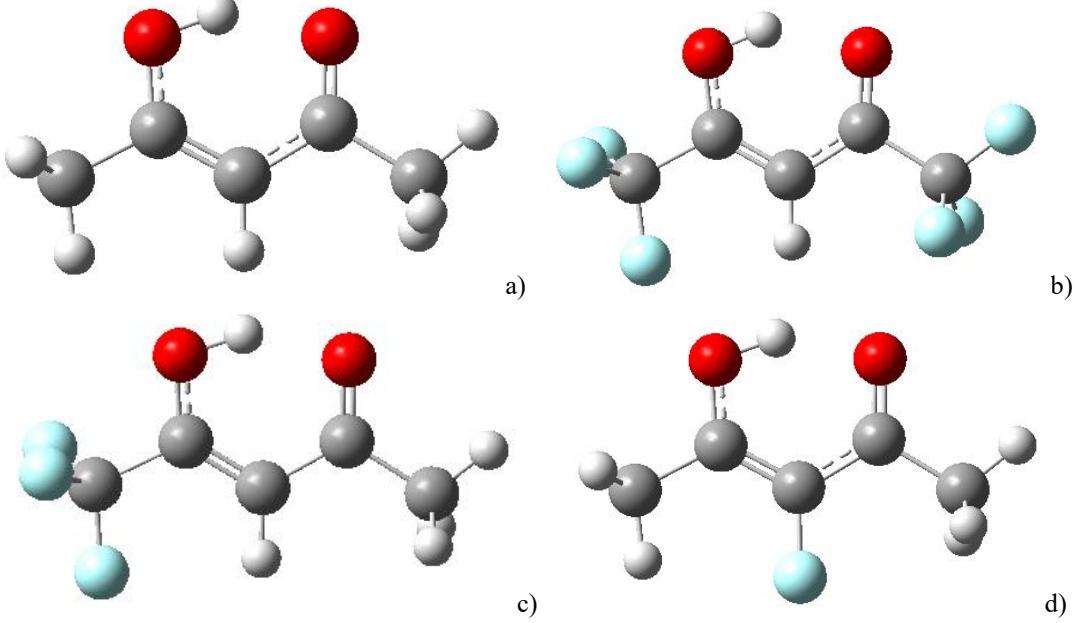
All calculations were performed using wB97XD/cc-pVTZ and B3LYP/cc-pVTZ level of theory. Some structural data of the hydrogen bridge of the molecules in hand collected in Table 1.
| Molecule | Structural and spectral parameters of hydrogen bridge | |||
|---|---|---|---|---|
| lOO [Å] | lOH [Å] | $\\delta_{\\scriptscriptstyle O-HH}$ [deg] | $\\omega_{O-H}$ [cm-1] | |
| AA | 2.53302 | 1.61394 | 149.56 | 2997 |
| AA-Br6 | 2.54906 | 1.65570 | 146.97 | 3175 |
| AA-Cl6 | 2.55650 | 1.66595 | 146.58 | 3183 |
| AA-F6 | 2.57490 | 1.69249 | 145.41 | 3197 |
| AA-Br3 | 2.53311 | 1.61411 | 148.78 | 3009 |
| AA-Cl3 | 2.53454 | 1.62001 | 148.17 | 3012 |
| AA-F3 | 2.53607 | 1.62890 | 147.68 | 3022 |
As one can see substitution by halogen atoms leads to the weakness of the H-bond in AA. The length of the hydrogen bridge increase in sequence Br, Cl, F. Simultaneously, in accordance with this sequence the frequency of the stretching O-H vibration, is rising. To analyze more careful O-H group vibrations some anharmonic calculations, as well as calculations with potential energy surface, were made too.