Supercontinuum generation is a phenomenon, when spectrum of a short pulse propagating through nonlinear medium extends hundreds or thousands of times [1]. Photonic crystal fibers (PCFs) are used as a nonlinear medium for generation of supercontinuum. The use of PCFs for supercontinuum generation enabled its use in frequency metrology, spectroscopy, optical coherent tomography, etc. [2] Since physical mechanisms of supercontinuum depend heavily on group velocity dispersion (GVD) of the PCF, it is very important to measure it precisely. Several methods for the measurement of optical fiber GVD are created. One of the methods, which allows to measure GVD in both anomalous and normal regions is called the analysis of geometrical microstructures. The drawback of this method is that it does not take into account that microstructures geometrical parameters throughout the length of the PCF might slightly vary [3]. A new method to estimate PCF GVD using supercontinuum generation and cross-correlation frequency-resolved optical gating (XFROG), recently demonstrated in Vilnius University, will be presented in this report.
To perform measurements of PCF dispersion, an optical setup, in which pump source for supercontinuum generation was Yb:KGW laser oscillator generating 1030 nm wavelength 76 MHz repetition rate and 110 fs duration pulses, was constructed. A beamsplitter was used to divide the radiation with the ratio of energy of 1:3 into two beams. The beam with more energy was used as a reference pulse for XFROG measurements. The other beam with less energy was used for the generation of supercontinuum in PCF. A highly nonlinear solid-core PCF with a core diameter of 4.6μm and a length of 32 cm was used. During XFROG measurement supercontinuum radiation and the reference pulse were non-collinearly focused for sum frequency generation into a 300 μm thickness BBO crystal, cut at $φ$=0° and $θ$=30° angles for type II phase matching. By changing the delay of the reference pulse sum frequency spectrum was measured ‒ spectrograms, which show sum frequency dependence from delay of the reference impulse were obtained.
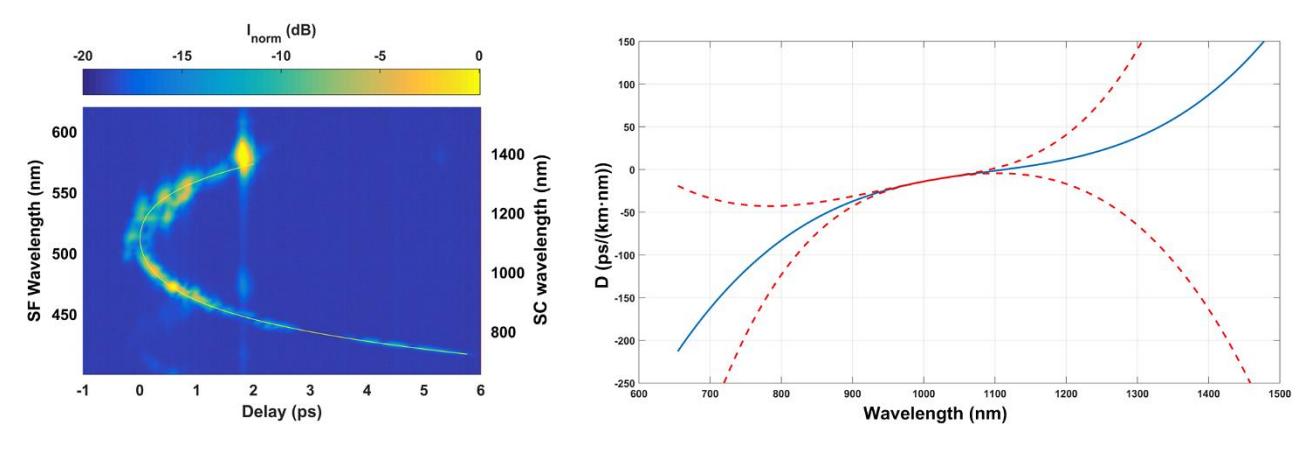
In this report it is shown, that when wavelength of pump radiation for supercontinuum generation is in the region of anomalous PCF dispersion which corresponds to the condition of rapid instantaneous spread of the spectrum, by analyzing the measured spectrograms it is possible to estimate dispersion of the PCF by approximating the XFROG trace with a polynomial function (Fig. 1). The bend point in the XFROG trace corresponds to the zero dispersion wavelength. For our PCF the zero of dispersion was at 1113.2 nm. Several measurements at various pump pulse energies were performed. WE determined that GVD measurement limits are determined by the limits generated supercontinuum spectra ‒ uncertainty interval in Fig.1 right graph increase rapidly when approximation goes to wavelengths were no supercontinuum was generated. The measurement results are in good qualitative agreement with the results provided by the manufacturer, which proves the accuracy and reliability of the novel GVD measurement method.