
During past decades, genuine product security has become an important issue for everyone including industry and government bodies. Many anti-counterfeiting techniques are developed for solving this serious problem. For instance, luminescent materials that emit visible light upon excitation with ultraviolet or near infrared radiation have been used as simple luminescent markers [1]. We represent the synthesis and optical properties of Pr3+ doped K2Bi(PO4)(MoO4) phosphors which can be successfully used for anti-counterfeiting luminescent pigment applications.
K2Bi1-xPrx(PO4)(MoO4) powder samples were prepared by conventional high temperature solid-state reaction. The stoichiometric amounts of high purity starting materials (Bi2O3, Pr6O11, MoO3, K2CO3 and NH4H2PO4) were mixed in an agate mortar employing acetone as grinding media. The obtained powder blend was transferred to the porcelain crucible and annealed at 600 °C for 10 h in air. The calcination procedure was repeated another two times [2].
The phase purity was confirmed by powder XRD measurements. Isostructural compounds of K2Bi(PO4)(MoO4):Pr3+ are obtained at any Bi3+/Pr3+ ratio what is in line with the Vegard's law [3], since the ionic size difference of Bi3+ (1.17 Å) and Pr3+ (1.126 Å) [4] is less than 15%.
The reflection, excitation and emission spectra of the single phase compounds were measured at room temperature and analyzed. The temperature dependent emission spectra and photoluminescence decay curves in 77–500 K temperature interval were also recorded for the samples doped with 0.5% and 25% Pr3+ ions. Thermal quenching activation energies and TQ1/2 values were calculated form the obtained data and shall be discussed in great detail.
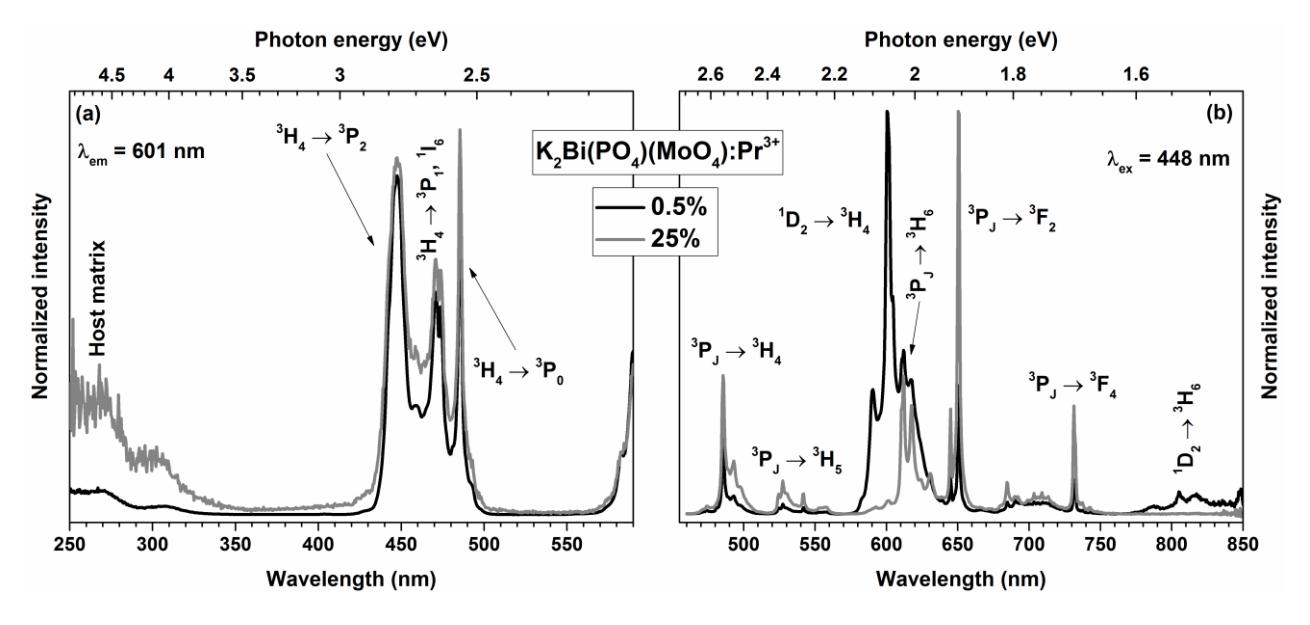
Fig. 1a shows normalized excitation spectra of 0.5% and 25% Pr3+ doped samples for 601 nm emission. The recorded spectra contain a broad band in the range of 250–350 nm and a set of lines in the range of 430–500 nm that can be assigned to the host matrix and 3H4 → 3PJ + 1I6 transitions of Pr3+ ions, respectively. The normalized emission spectra of K2Bi(PO4)(MoO4):Pr3+ phosphors doped with 0.5% and 25% Pr3+ under 448 nm excitation are depicted in Fig. 1b. The spectra contain seven sets of emission lines that originate from 3PJ and 1D2 excited states to the 3HJ and 3FJ terminal states. The strongest emission intensity was obtained for the sample doped with 0.5% Pr3+.
It also turned out that the increase of Pr3+ concentration leads to a strong concentration quenching due to cross relaxation processes. Besides, the profile of emission spectra could be altered just by changing the Pr3+ content in the structure. Samples with higher Pr3+ concentration possess rather unique emission spectra and, therefore, could be applied in luminescent security markers, where such properties are highly desired.