
In recent years, mortality of renal cancer (RCa) has been increasing in Lithuania because there are no symptoms about oncologic changes in organism. According to statistical data, about 50% of RCa cases are determined accidentally, e.g. during ultrasound examinations. Prostate cancer (PCa) is the most frequent oncologic disease of men in Lithuania and the second one worldwide. Increased levels of prostate-specific antigen (PSA) in blood are used as a diagnostic indicator of PCa. However, PSA screening has relatively high rates of false-positive and false-negative results, thus, it lacks specificity. Nowadays, epigenetic tools such as DNA methylation analysis could be used as effective measure to investigate early changes in renal and prostate tissues. Our aim was to investigate promoter methylation status of metallothionein coding genes as potential new biomarkers for renal and prostate cancer diagnosis.
In total, 80 samples – 40 RCa, 10 peritumoral (PRT), and 30 noncancerous renal tissues (NRT) – from 30 RCa patients and 202 samples – 151 PCa and 51 noncancerous prostate tissues (NPT) – from 176 PCa patients were analyzed in the present study. Extracted genomic DNA was modified by bisulfite treatment and methylation-specific PCR (MSP) was used to analyze the promoter hypermethylation status of selected metallothionein genes: MT1E, MT1F, and MT1G. Adenomatous polyposis coli gene (APC), a widely studied tumor suppressor, was included for comparison.
In RCa cases, promoters of the MT1E, MT1F, and MT1G genes were methylated in 33%, 0% and 10% of tumors, respectively (Fig. 1A). Only methylation of MT1E gene was significantly more frequent in RCa as compared to NRT samples (P = 0.0059). The differences of methylation frequencies between RCa and PRT were not statistically significant for all three genes. MT1E was also more frequently methylated in RCa cases with larger tumor size and smaller patient's waist circumference (P = 0.0110 and P = 0.0195, respectively). No associations were observed between promoter methylation status and RCa patients' age, sex, tumor stage, or Fuhrmann grade.
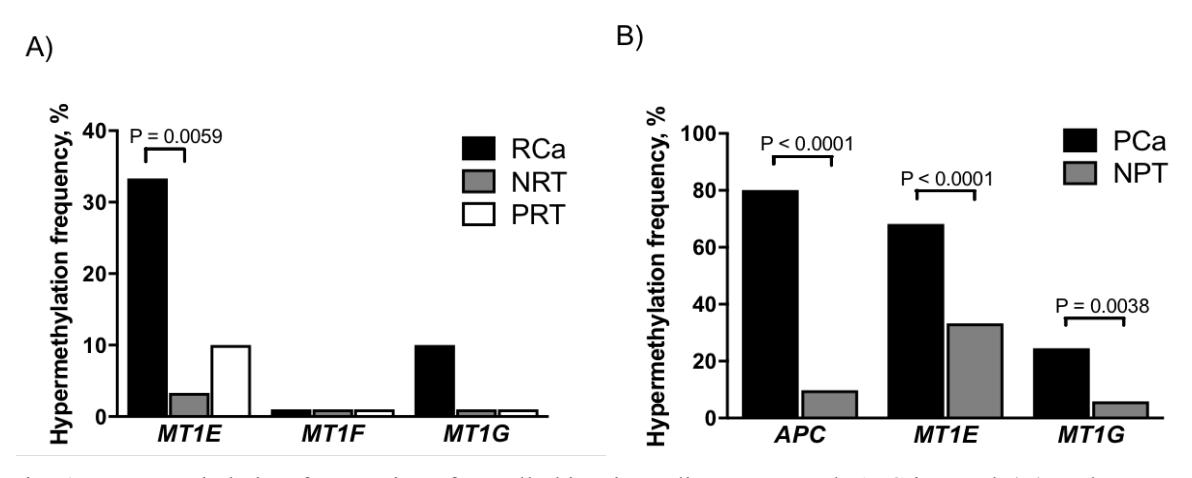
In PCa cases, promoters of the APC, MT1E, and MT1G genes were methylated in 80%, 68%, and 25% of tumors and in 10%, 33%, and 6% of NPT, respectively (Fig. 1B). The differences of methylation frequencies between PCa and NPT were statistically significant for all three genes (P < 0.0001, P < 0.0001, and P = 0.0038, respectively). APC and MT1G were frequently methylated in PCa of advanced tumor stage (≥pT3 vs. pT2; P = 0.0117 and P = 0.0054, respectively) and in cases with biochemical disease recurrence (P = 0.0144 and P = 0.0073, respectively). Moreover, PCa patients with methylated MT1G status had significantly larger prostate mass (P = 0.0024). No correlations were determined between promoter hypermethylation and patients' age, preoperative PSA level, or Gleason grade groups, defined according to International Society of Urological Pathology.
In conclusion, our study identified promoter methylation of MT1E as a novel biomarker for diagnostics of RCa or PCa, while methylation of APC and MT1G could be exploited as potential prognostic biomarkers of PCa progression.