
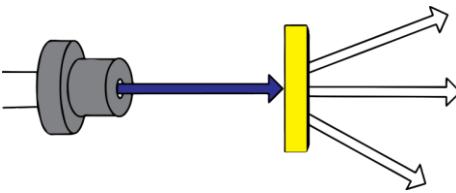
Laser diodes (LDs) based lighting is expected to become the main high power Solid-State-Lighting technology as it provides efficient and colour-stable white light [1]. Luminairy is usually made of a blue or UV laser diode and a remote yellow phosphor which converts part of LD's light to yellow (Fig. 1). LDs based lighting has a higher light intensity per area which is needed in some quasi-point source applications such as car headlamps, projectors and narrow beam outdoor torches. The main challenge of LDs based luminairies is stable operating at high temperatures. Temperature of phosphors rises because of energy loses due to nonradiative photoluminescence (PL) decay and Stokes shift. Huge amount of not dissipated heat can cause the increase of temperature which leads to the degradation of phosphor and the changed colour of luminairy. For this reason it is important for a phosphor to have as good thermal stability and conductivity as possible [2]. To solve this task scientists are developing new materials and techniques. One way to increase thermal conductivity of phosphor is to change media in which phosphor powder is dispersed. While commercial LED luminaries are usually made of phosphors which are dispersed in silicon, holding media can be changed to glass or other high thermal conductivity transparent material. Steady temperature can also be maintained by using rotating phosphor wheel. Finally, ceramic or bulk phosphors can be used for even higher thermal stability but it requires more complicated phosphor production technologies and therefore are more expensive [3, 4].
In this work the photoluminescence properties of the group of samples made of YAG:Ce3+ phosphor and boron nitride (BN) powders are presented. Some of the samples also contain two types of polymers (M280 ir M600) which were used for better mechanical properties. Different samples contain different concentrations of phosphor, BN and polymer. Photoluminescence emission spectra have been measured for all samples under 450 nm excitation, PL quantum yields have been measured in integrating sphere while PL lifetimes have been measured using frequency domain method using 450 nm laser diode excitation. Samples thermal properties were also evaluated.
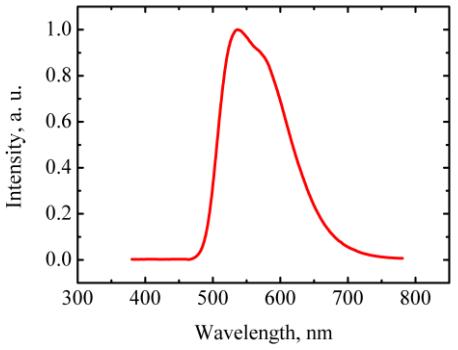
The results have shown that photoluminescence emission spectra do not depend on sample's composition (Fig. 2.) while PL quantum yield strongly varies between different samples. It is also shown that YAG:Ce3+/BN samples have a good thermal conductivity and thermal stability of photoluminescence properties.