1 Laser Research Center, Vilnius University, Lithuania
2 Femtika Ltd., Lithuania
3 Faculty of Chemistry and Geosciences, Vilnius University, Lithuania
4 Research Institute of Electronics, Shizuoka University, Japan
5 Departament de Física, Universitat Politcnica de Catalunya, Spain
6 Instituci Catalana de Recerca i Estudis Avancats, Spain
7 Swinburne University of Technology, Australia
8 Melbourne Centre for Nanofabrication, ANFF, Australia
Direct laser writing (DLW) lithography, known as two-photon polymerization (2PP) is a technique for micro- and nano-structuring that allows fabrication of complex 3D objects. We present a systematic study on post process heat treatment's influence on direct laser structured non-photosensitized [1] organic-inorganic photoresist SZ2080 material. The effects of pyrolysis on polymer micro- and nano-structures have been firstly studied in relatively low heating temperatures [2]. It is observed that post-process heat treatment method improves the resolution and reduces dimensions of structures fabricated with 2PP in organic-inorganic materials [3, 4].
We used various geometry structures fabricated from ultra-low shrinkage Si and Zr containing polymer SZ2080 using the DLW method and applied a hard bake procedure that reduces it into a more inorganic spatially shrunk 3D structure. We performed heating in air, Ar and O2 gas environments while the temperature ranged from 200 to 1500 °C at varied time intervals. We examined the resulting properties of different structures, mainly focusing on geometry retention, e.g. bulk structures, scaffolds of macroscopic dimensions, woodpile photonic crystals (photonic-bandgap). In addition, we tested the material resiliency to plasma etching, FIB milling and wet etching by acid.
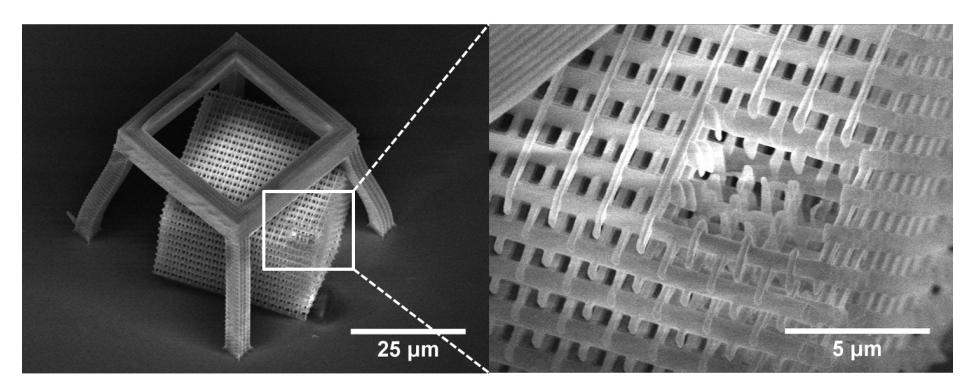
The results of the research shows that the geometry of the structures can be permanently and homogeneously scaled down to 60 % of their original size and the structures also showed an increased resiliency to FIB milling (Fig. 1). We confirmed that heat treatment has reduced the organic part of the material leaving the glass-ceramic component of the hybrid. In conclusion, the heat treated DLW structured photoresist SZ2080 is a good candidate as an engineering material for hot and reactive environments.
Fig. 1. SEM micrograph of a woodpile photonic crystal, which shrunk and retained its geometry during heat-treating at 300 °C for 3 h, and FIB milling. Inner geometry is revealed on the right. Resiliency to milling is observed.
[1] L. Jonušauskas, D. Gailevičius, L. Mikoliūnaitė, D. Sakalauskas, S. Šakirzanovas, S.Juodkazis, M. Malinauskas, Optically Clear and Resilient Free-Form μ-Optics 3D-Printed via Ultrafast Laser Lithography, Materials10, 12 (2017).
[2] K. Takada, K. Kaneko, Y. D. Li, S. Kawata, Q. D. Chen, and H. B. Sun, Temperature effects on pinpoint photopolymerization and polymerized micronanostructures, Appl. Phys. Lett.92, 041902 (2008).
[3] J. Li, B. Jia, and M. Gu, Engineering stop gaps of inorganic-organic polymeric 3D woodpile photonic crystals with post-thermal treatment, Optics Express16(24), 20073 (2008).
[4] G. Seniutinas, A. Weber, C. Padeste, I. Sakellari, M. Farsari, C. David, Beyond 100 nm resolution in 3D laser lithography - post proccessing solutions, Microelectron. Eng. in press (2018).