
Luminescent materials, also known as phosphors, are widely used in nowadays. Optical technologies, emissive displays, fiber-optic telecommunication systems, lasers, etc. are the area of major applications. In last two decades, many new phosphors that are more efficient than the previous ones were invented. Inorganic phosphors are composed of an inert host lattice and optically active ion (activator), for example $Cr^{3+}$, $Ce^{3+}$, $Eu^{3+}$, $Tb^{3+}$, etc.1-4
For a successful growth of plant the photo-physiological processes need to be satisfied and this requires light in far-red (700 – 760 nm), red (620 – 680 nm), and blue (400 – 500 nm) spectral ranges 5. Chromium doped garnets are perfect candidates for this purpose. It is well known that yttrium aluminum garnet (YAG) doped $Cr^{3+}$ possess a broad absorption bands at ca. 450 and 650 nm. These bands correspond to $^4A_2 \rightarrow ^4T_1$ and $^4A_2 \rightarrow ^4T_2$ transitions, respectively. Emission originates in red and far-red spectral region with $^2E \rightarrow ^4A_2$ transition at around 610 – 800 nm 6, 7.
External quantum efficiency (EQE) is very important factor for phosphors in their practical evaluation 8. G. A. Torchia et al. has reported that LiNbO3:ZnO:Cr3+ congruent crystal exhibit $10\%\pm2\%$ absolute quantum yield 9, while the luminescent quantum yield for the Cr3+ doped Cs2NaAlF6 was found to be $68\%\pm3\%$ 10. S. S. Pedro et al. has demonstrated that the quantum yield for Be3Al2(SiO3)6:Cr3+ and Cs2NaAlF6:Cr3+ crystals varied from 54% up to 78% depending on host lattice and dopant concentration . The quantum efficiency (QE) of YAG depends on its phase purity. Besides garnet phase, there are two intermediate phases: Y4Al2O9 – yttrium aluminum monoclinic (YAM) and YAlO3 – yttrium aluminum perovskite (YAP). If any of these phases coexist, the quantum efficiency decreases 11.
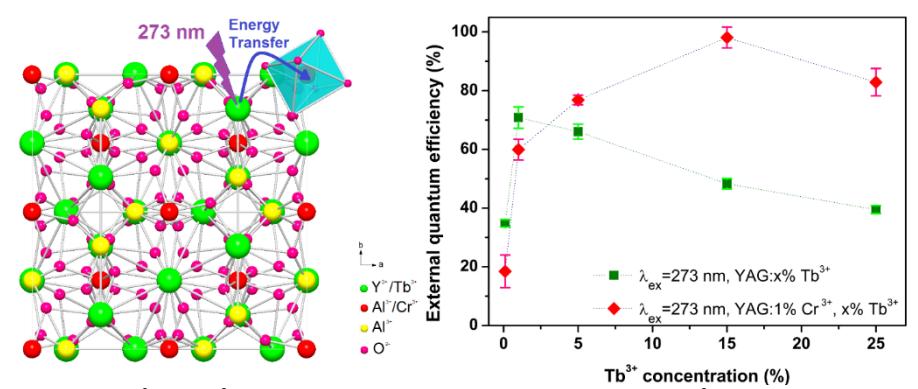
Strong absorption and high quantum efficiency are the key features for any phosphor. Chromium and terbium co-doped yttrium aluminum garnets (YAG) are perfect candidates for luminescence. All samples of doped and co-doped YAG were prepared by the sol-gel route which is advantageous and useful to obtain single phase garnets. Samples were annealed at 1500 °C in order to avoid crystal lattice defects and to obtain better luminescence properties. It was found out, that optimal $Tb^{3+}$ doping concentration in YAG:x%Tb3+ was x = 1% with external quantum efficiency (EQE) of nearly 71%. Optimal $Tb^{3+}$ co-doping concentration in YAG:1%Cr3+,x%Tb3+ was x = 15% with EQE of more than 98% (excited at 273 nm). All series of samples of YAG:Tb3+ and YAG:Cr3+,Tb3+ were characterized by X-ray diffraction analysis, steady state and kinetic luminescence measurements.