
Thin films are widely used in laser systems. Rapid development in laser technologies forces an increase in investigations for optical components suitable for high power laser systems. In order to produce high quality thin films, deposition technologies are constantly improved and influence of deposition parameters investigated. The main parameter that represents durability of optical components is laser induced damage threshold (LIDT), which describes the amount of energy that component can withstand without the occurrence of irreversible change. In typical high reflection mirrors, high refractive index material limits LIDT because of low bandgap value.
Glancing angle deposition (GLAD) technology allows to form the so called sculptured thin films (STF) and produce optical components (including mirrors) using only one high band gap material [1]. STFs are formed by directing vapor flux towards the substrate at oblique angle, when substrate itself is rotated around its axis. Because of low adatom mobility and collimated vapor flux, shadowing effect takes place which results in film growth of separate columns and void regions [2]. Various deposition angles and substrate rotation algorithms allow to manipulate thin films inner structure and optical properties. Induced porosity in STFs further increases their laser resistance making them the promising solution for high power laser systems.
The aim of this research is to investigate the influence of deposition parameters for high reflectivity SiO2 mirrors. The effect of deposition rate and oxygen partial pressure for optical and structural properties of multilayer mirrors was studied.
Two sets of samples were produced using electron beam evaporation plant: five 30 layer mirrors deposited at different rates and three 60 layer mirrors (Fig. 1) deposited at different oxygen partial pressures. Spectroscopic, SEM, AFM and LIDT measurements were performed to determine the influence of these deposition parameters.
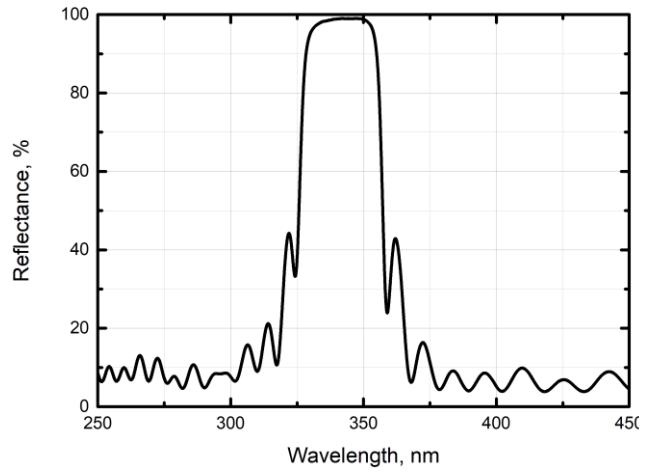
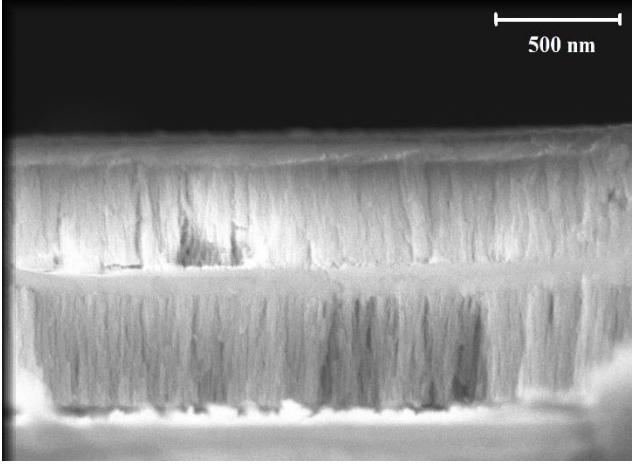
Spectroscopic and surface roughness measurements have shown very similar results for all deposition rates. From SEM images (Fig. 2) it was determined that nanostructures of multilayers remain very similar in studied deposition rate interval. The average film column widths for 3 Å/s and 15 Å/s deposition rates were 30.9 nm and 30 nm, respectively. Changing the oxygen partial pressure was shown to have great impact on spectral properties for SiO2 mirrors. Reflectance bandwidth and spectral region of SiO2 mirrors were highly dependent on partial pressure. Also, the average surface roughness of 60 layer SiO2 mirror was found to be nearly 2 times higher (1.46 nm) than 30 layers SiO2 mirror (0.77 nm).
This study shows that from 3 Å/s to 15 Å/s deposition rate interval spectral properties of SiO2 high reflectance mirrors remain the same, because of the stability of structural properties. Therefore it is possible to produce SiO2 mirrors at higher rate without sacrificing quality. Reflectance maxima shift to infrared region with the decrease of oxygen partial pressure, possibly because of scattering of vapor flux. Furthermore, environmental conditions have high infuence for spectral properties of GLAD thin films and should be investigated further.