
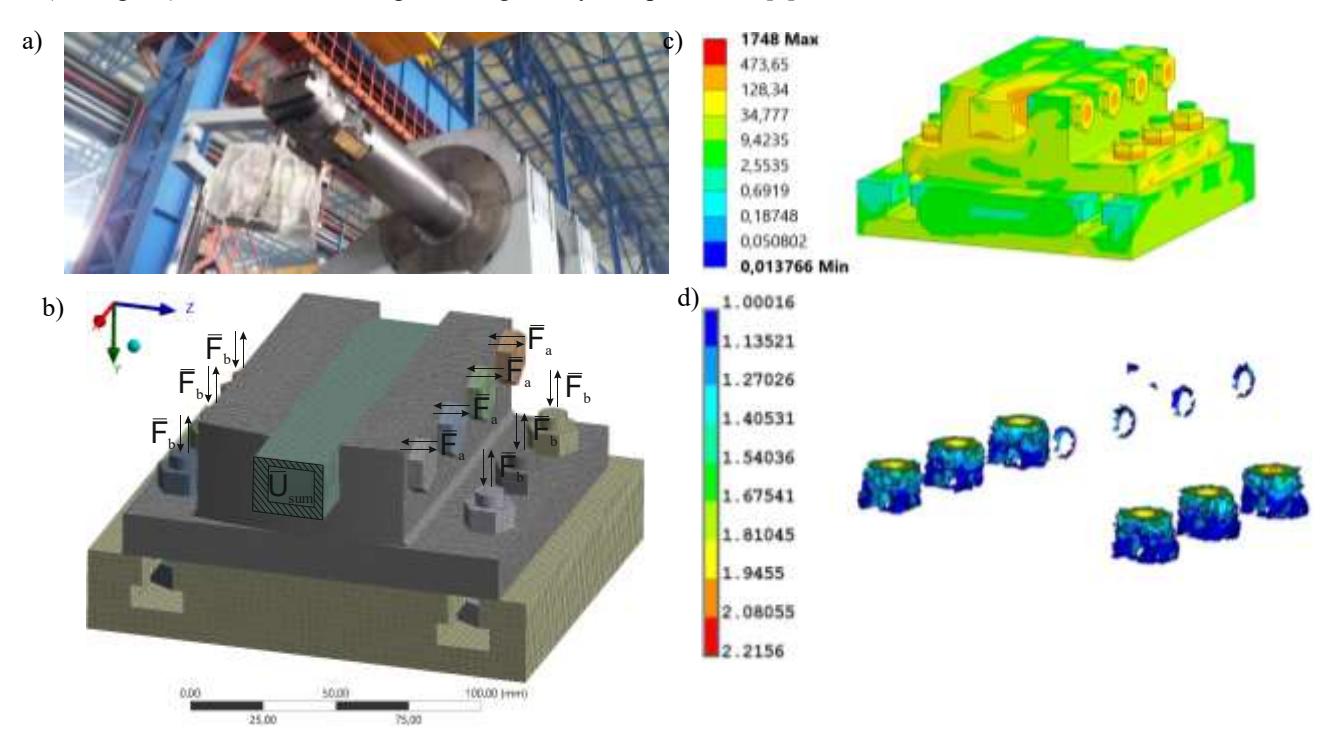
Multi-element tribo-fatigue boring bar front-end structure, which is one of the most critical components of heavy-duty horizontal boring lathe (see Fig. 1a) is studied in this work. The structure contains contact interactions with friction between its various elements and a non-contact bending.
The aim of the work was to improve cutting process on the existing super heavy-duty horizontal boring lathe by carrying out computer simulations for determining stress-strain state of front-end structure of new design. Another aim of this work was to determine the positions of the system elements for minimizing damageability of the system while increasing the boring radius.
For that purpose computer finite-element models considering two phases of loading: bolts pretension and cutting process in spatial static statement were created [1]. All elements of the system consist from the 18HGT steel.
Firstly, it was shown that if motion of only two upper bases is considered then there is no reason to model full front-end structure with the boring bar. After that, several calculations of the front-end structure were made from which boundary conditions for the submodel, shown in Fig. 1b, were applied for the cutting edges.
During submodeling, elementary classical analysis based on the distributions of the stress tensor components was held for every part of the system (see Fig. 1c). Then for obtaining more precise results the analysis of dangerous volumes (see Fig. 1d) and volumetric integral damageability was performed [2].
According to the results of the research, it is recommended to apply rigid fixing of the upper base in the position closest to the center of the middle base in order to minimize the volumetric damageability of the system.