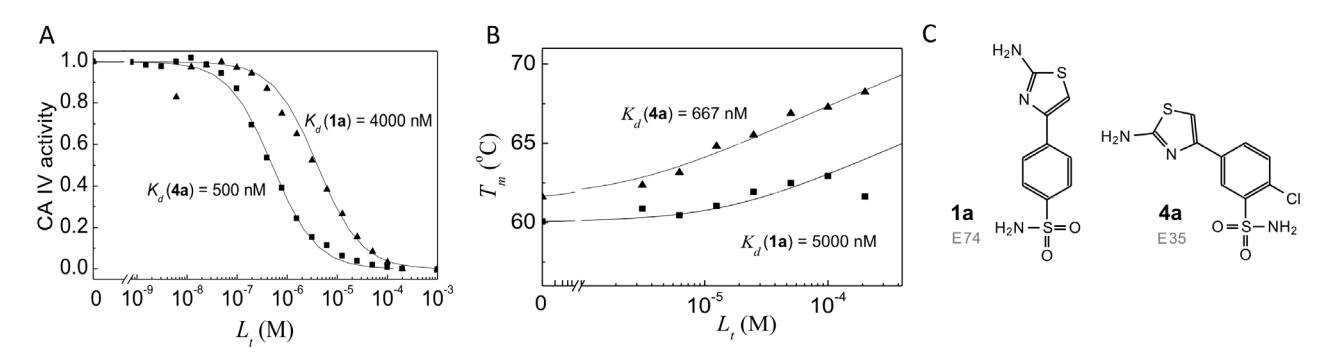
Studies of the interaction between proteins and small molecules are important due to two main reasons: first, this research is helpful for rational drug design and, second, it is necessary to deepen the understanding about molecular interactions, which are still relatively poorly understood. In this study, target proteins are human catalytically active carbonic anhydrase (CA) isoforms. These proteins are zinc containing metalloenzymes, which have high similarity of the active site and participate in many physiological processes. On the other hand, CAs have different tissue, subcellular localization and this causes that each isozyme is associated with different pathology or disease [1]. Thus, controlling the catalytic activity of only one, desease associated, enzyme would help to avoid side effects, which are inherent to many drugs.
It is well know that sulfonamides bind to the zinc ion in the active site of CA and inhibit its catalytic activity [2]. Furthermore, different substitutions of benzenesulfonamides (or other suflonamides) have different affinity to CAs. Tracking the changes of the chemical structures of compounds (inhibitors) and selectivity or affinity for CAs could be useful for the lead compound (potential drug) optimization.
Scientists have tested the CA binding affinities of various nitrogen-containing heterocycles (such as pyrrole, oxazole, furazane, etc.) attached to benzenesulfonamide, but there were no studies about thiazolylbenzenesulfonamides and their affinity to CAs. Thus, in this study, para and meta - substituted thiazolylbenzenesulfonamides with chlorine atom in ortho position were synthesized, observed affinities to all 12 catalytically active recombinant human CA isoforms were determined by the fluorescent thermal shift assay (Fig. 1B) and the pH-independent (intrinsic) affinities were calculated. Moreover, several other methods (stopped-flow CO2 hydration assay (Fig. 1A) and X-ray crystallography) were used to prove that these thiazole-substituted benzenesulfonamides act as CA inhibitors. The correlation between chemical structures of compounds and intrinsic affinities to CAs was determined and the conclusions about the energetic contributions of the thiazole ring and its substituents were made.