
Breast cancer (BC) is the most common malignant disease among women in the world. Mutations of various cancer-related genes is commonly associated with BC. Tumor protein 53 gene (TP53) mutations has been found in about 30% inherited and 20% sporadic BC cases [1]. Tumors with mutated TP53 has a higher rate of pathological response to cytotoxic chemotherapy than wild-type (wt) TP53 tumors. Furthermore, TP53 mutations are more frequent in BC cases of advanced stage, with affected lymph nodes, positive for Ki67 expression, and in tumors showing aggressive behavior, like triple negative BC (TNBC) [2]. Therefore, the aim of the present study was to evaluate TP53 mutation status in BC and examine associations with clinical-pathological and immunological parameters.
Tissue samples were collected from 116 BC cases during 2007-2009 at National Cancer Institute. TP53 mutation analysis was performed using Sanger sequencing, single-strand conformation polymorphism (SSCP), and next-generation sequencing methods.
At least one TP53 mutation was identified in 29% (34 of 116) BC cases. The vast majority of mutations were detected within DNA binding domain (75%, 21 of 28), particularly in exon 8 (25%, 7 of 28). Single nucleotide substitutions were the most common type of alterations (86%, 24 of 28), whereas deletions of various length (up to 23 bp) comprised 11% (3 of 28) as well as 2 bp inversion (3%, 1 of 28). TP53 mutations were more frequently detected in poorly differentiated tumors (G3) as compared to moderately differentiated ones (58% and 9%, respectively; P < 0.0001). Moreover, high mutation frequency was significantly associated with TNBC subtype (81%, 13 of 16) in comparison to luminal A (9%, 5 of 54, P = 0.0001), luminal B (38%, 9 of 23; P = 0.0201), and HER2+ BC subtypes (30%, 7 of 23; P = 0.0031) (Fig.1.). Particularly, TP53 mutations were more common in estrogen receptor-negative, progesterone receptor-negative, and Ki67-positive tumors (P < 0.0001, P = 0.0039, and P < 0.0001, respectively).
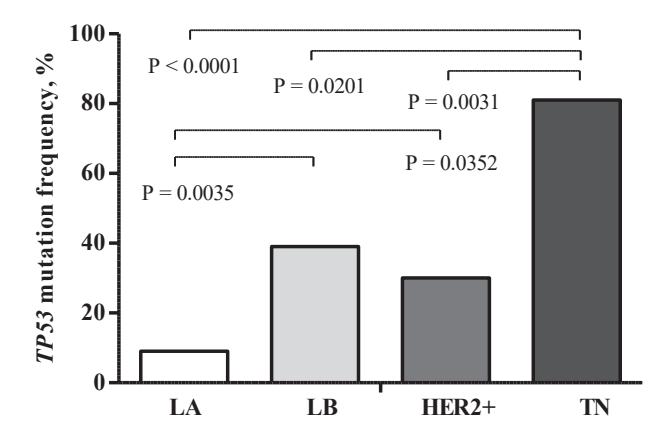
In conclusion, our study revealed differences in TP53 mutation rate among various BC subtypes, which might facilitate tumor differentiation at diagnosis and assist in treatment decision making, which is currently based on hormone receptor status.