
Room-temperature ionic liquids (IL's), also called liquid salts, are considered to be a promising alternative to conventional organic solvents due to their appealing features such as low vapor pressure, thermal stability, high ionic conductivity. However, due to their high hygroscopicity, it is very difficult to synthesize and maintain pure ionic liquids, therefore it is relevant to study the influence of water on the properties of ionic liquids. Ionic liquids based on 1-butyl-3-methylimidazolium cation, [C4mim], and tetrafluorborate, [BF4], or chloride, [Cl], anions are highly hygroscopic. Water affects various properties of these ionic liquids, including structural and dynamical parameters on the molecular level [1, 2]. The structure of ionic liquids is not easy to study experimentally as these systems obviously do not possess a periodic lattice. Molecular dynamics (MD) simulations on the other hand is a promising method to determine structural properties of ionic liquid and water mixtures. The main purpose of this study is to analyze structural changes of ionic liquids based on 1-butyl-3-methylimidazolium (Fig. 1) with the increasing water content in these systems. We are thus simulating early stages of the formation of the so called water pockets the existence of which has been earlier predicted theoretically using MD simulations and recently confirmed experimentally [2].
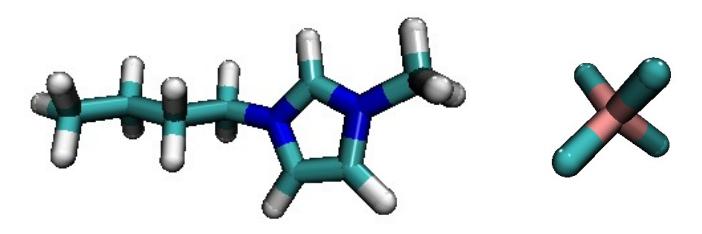
Classical MD simulations of pure ionic liquids [C4mim][BF4] and [C4mim][Cl] as well as their mixtures with water were conducted using AMBER type of force fields. The force field parameters used for 1-butyl-3-methylimidazolium and the anions were proposed by Liu et al. [3]. Water was represented by a standard TIP3P model. After proper equilibration in the NPT ensemble, final sampling of the trajectory for the duration of a few nanoseconds was performed in the NVT ensemble. AMBER program was used to conduct all the simulations in this work.
Analysis of the recorded trajectories allowed us to investigate structural changes in the local structure of IL with the rising size of the water droplets. Radial and angular distribution functions as well as relevant coordination numbers were obtained, e.g. coordination number for H2 varies from 1.6 (to chlorine) in [C4mim][Cl] to 1.7 for boron atoms in [C4mim][BF4] for pure ionic liquids. The local structure around the H2 proton in the imidazolium ring of the 1-butyl-3-methylimidazolium as well as around the water molecules was under particular scrutiny.