
Using femtosecond laser pulses to induce plasma on the surface of the sample allows laser energy to be absorbed before the generation of the plasma has started, which leads to a more effective usage of the laser energy than in the longer pulse case. Because of this reason femtosecond laser pulses allow carrying out laser micromachining, monitoring process and online control with low energy pulses. Double or multiple pulses are used to improve the analytical performance of laser induced breakdown spectroscopy (LIBS) and to increase the rate in laser material processing [1].
In this work we have focused on a comparison of single and multiple pulse femtosecond laser induced breakdown spectroscopy analysis, specifically for femtosecond laser systems. In the experiment we investigated the intensity of the plasma in dependence on a variety of parameters. The total pulse energy was kept equal (with maximum energy of 80 μJ) for plasma excitation by single and multiple pulses. The experiments were carried out using the CARBIDE (Light Conversion) laser system with pulse duration 290 fs and power up to 5 W at 1030 nm wavelength, with repetition rate of 60 kHz. We analyzed the plasma spectrums recorded at different scanning speeds, different delays, and their dependence on the number of scans. The collected data allowed us to evaluate the enhancement of the LIBS signal, which was achieved while conducting the experiments with multiple pulse LIBS system.
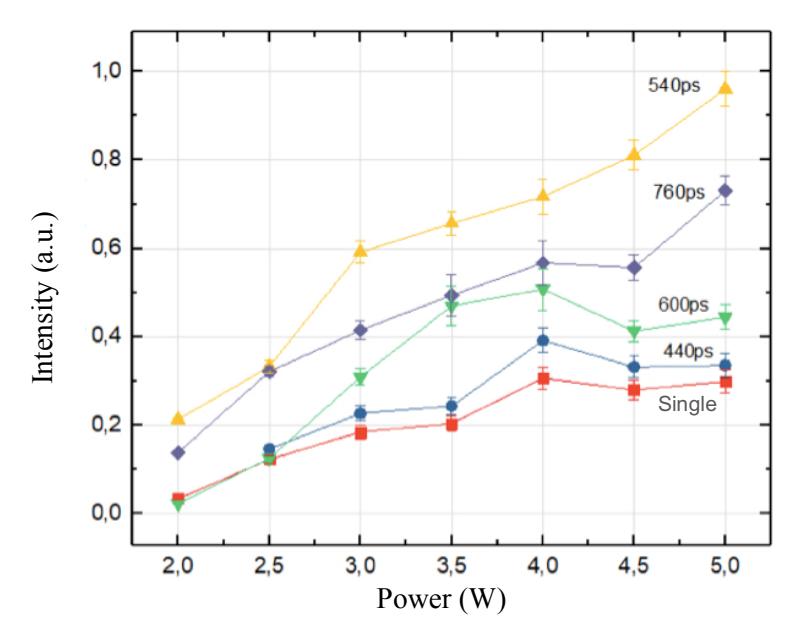
The enhancement was observed while recording LIBS in multiple pulse mode when compared to the single pulse mode with all different delays in the range of 440 - 760 ps between the multiple pulses. In case of the highest enhancement, the intensity of laser plasma induced by multiple laser pulses were ~3 times greater, than in the case of single laser pulse excitation regime by using the same pulse energy. Thus, the time of plasma observation can be successfully extended when using multiple laser pulses.
Figure 1 shows the comparison between multiple pulse LIBS signals with different delays. All signals were recorded while processing soda-lime glass in dependence on the average laser power. From the picture we can see that LIBS signal can be enhanced up to 3 times by using multiple pulse, instead of single pulse regime.
In essence, the optical system assembled for plasma excitation by multiple femtosecond laser pulses can be applied for the conduction of a precise analysis of material, allowing to detect elements of low concentrations in the sample.