
Terahertz (THz) radiation represents the region in the electromagnetic spectrum between far-infrared and microwave radiation and has frequency between 0.1 THz and 10 THz (wavelength varies from 3 mm to 0.03 mm). Terahertz radiation has been investigated by scientists and engineers for over a decade; however compact and efficient THz sources and detectors are still to be developed. Therefore the research efforts in this field are rising, because THz radiation has many interesting and unique properties: for example it is non-ionizing and safe for the living organisms. Moreover, it can easily pass through wood, paper, clothing, various plastics and ceramics. Furthermore, rotational and vibrational transitions of various molecules have energies in THz frequency range. This leads to a wide range of applications, such as spectroscopy, biological and medical imaging, detection of hazardous materials, security screening, etc.
As a pump source the Ti:Sapphire laser system (central wavelength about 790 nm) operating at 1 kHz and delivering 9 mJ pulses of 35 fs (FWHM) duration was used. THz radiation and prepulse were generated in ambient air with energies of 5.2 and 1.65 mJ respectively. In the experiment THz radiation was generated by mixing laser and its second harmonic pulses (bichromatic pump [1]) and prepulse was generated using fundamental harmonic only. The prepulse was propagated and focused in the orthogonal direction with respect to the main beam to generate a plasma filament that intercepted the main beam path.
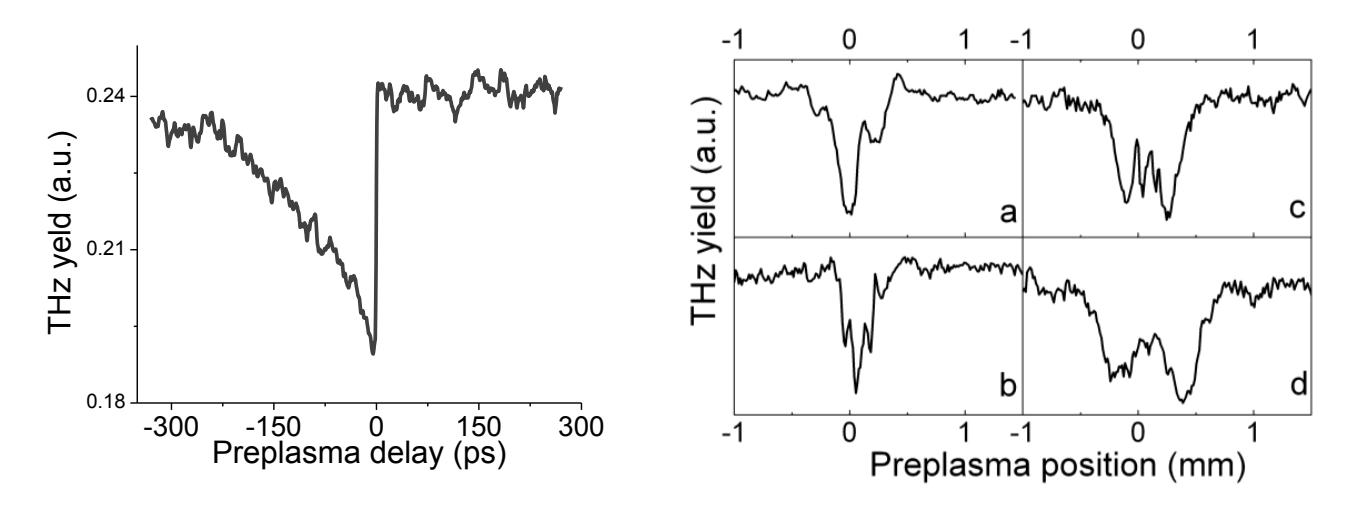
During the experiments the dependencies of various THz radiation properties depending on position, delay and power of prepasma been investigated (Fig. 1). The THz signal significantly decreases when the precreated plasma is present in the path of the pump beam. The impact of the preplasma on the yield of THz generation was strongly dependent on the timing between the pump pulse and prepulse: the amplitude of THz signal didn't change when the prepulse was sent after the main pulse, and rapidly decreased, when the delay between these pulses reversed the sign. After the initial dropdown the THz signal slowly recovered with a time constant of a few hundred picoseconds (Fig. 1 (left)). In addition, the dependence of THz attenuation on the mutual position of two plasma filaments have been observed: depending on the position of interception point along the main beam (along the z coordinate axis) the THz yield as a function of preplasma position along the y coordinate mainly had either one or two minimum (Fig. 1 (right)). Obtained results of preplasma interaction with THz generating filament could be explained by at least two different mechanisms: pump beam diffraction and THz radiation screening induced by preplasma filament [2].